Home
| About
| Mine Tracker
| RSS
| Footer
▄▄▄▄▄▄▄▄▄▄▄▄▄▄▄▄▄▄▄▄▄▄▄▄▄▄▄▄▄▄▄▄▄▄▄▄▄▄▄▄▄▄▄▄▄▄▄▄▄▄▄▄▄▄▄▄▄▄▄▄▄▄▄▄▄▄▄▄▄▄▄▄▄▄▄▄▄▄▄▄▄▄▄▄▄▄▄▄▄▄▄▄▄▄▄▄
█▄▄░▄▄█░▄▄▀█░▄▄▀█▀▄▀█░▄▄███░▄▄▀█░▄▄▀█░▄▀███▄▄░▄▄█░▄▄▀█░▄▄▀█▀▄▀█░▄▄█░▄▄▀█░▄▄▀██▄██░███▄██▄░▄█░██░
███░███░▀▀▄█░▀▀░█░█▀█░▄▄███░▀▀░█░██░█░█░█████░███░▀▀▄█░▀▀░█░█▀█░▄▄█░▀▀░█░▄▄▀██░▄█░███░▄██░██░▀▀░
███░███▄█▄▄█▄██▄██▄██▄▄▄███▄██▄█▄██▄█▄▄██████░███▄█▄▄█▄██▄██▄██▄▄▄█▄██▄█▄▄▄▄█▄▄▄█▄▄█▄▄▄██▄██▀▀▀▄
▀▀▀▀▀▀▀▀▀▀▀▀▀▀▀▀▀▀▀▀▀▀▀▀▀▀▀▀▀▀▀▀▀▀▀▀▀▀▀▀▀▀▀▀▀▀▀▀▀▀▀▀▀▀▀▀▀▀▀▀▀▀▀▀▀▀▀▀▀▀▀▀▀▀▀▀▀▀▀▀▀▀▀▀▀▀▀▀▀▀▀▀▀▀▀▀
State of Supply Chain sustainability 2021 MIT report
https://sscs.mit.edu/wp-content/uploads/2021/07/State-Sustainable-Supply-Chains-MIT-CSCMP.pdf
This year's report sheds light on how companies put their SCS promises into practice. Of the many ways to accomplish this, three common approaches emerged, including supplier development, supply chain visibility, and environmental impact reduction. Supplier development was the most common across all industries; however, visibility proved equally attractive in manufacturing and transportation.
As the supply chain sustainability field advances, so does this report, and this year we introduce a classification of companies based on behaviors related to SCS. The model, called the SCS Firm Typology, yields fresh insights into the state of sustainability in supply chains. Categories of firms range from low? effort enterprises with little engagement in SCS to highly committed leaders. This typology distills the report's analyses into an interpretable model and enables future exploration of the evolution of SCS across multiple dimensions.
https://sscs.mit.edu/wp-content/uploads/2021/07/State-Sustainable-Supply-Chains-MIT-CSCMP.pdf
This year's report sheds light on how companies put their SCS promises into practice. Of the many ways to accomplish this, three common approaches emerged, including supplier development, supply chain visibility, and environmental impact reduction. Supplier development was the most common across all industries; however, visibility proved equally attractive in manufacturing and transportation.
As the supply chain sustainability field advances, so does this report, and this year we introduce a classification of companies based on behaviors related to SCS. The model, called the SCS Firm Typology, yields fresh insights into the state of sustainability in supply chains. Categories of firms range from low? effort enterprises with little engagement in SCS to highly committed leaders. This typology distills the report's analyses into an interpretable model and enables future exploration of the evolution of SCS across multiple dimensions.
First use of the word supply chain
https://www.supplychainopz.com/2013/05/history-of-logistics.html

In 1905, The newspaper "The Independent" published the article that contained the word "Supply Chain" for the first time
https://www.supplychainopz.com/2013/05/history-of-logistics.html
In 1905, The newspaper "The Independent" published the article that contained the word "Supply Chain" for the first time
First use of the word logistics
https://www.supplychainopz.com/2013/05/history-of-logistics.html

The word "Logistics" began in January 1810 on the "Scots Magazine, and Edinburgh Literary Miscellany for January 1810"
https://www.supplychainopz.com/2013/05/history-of-logistics.html
The word "Logistics" began in January 1810 on the "Scots Magazine, and Edinburgh Literary Miscellany for January 1810"
MANIFEST: Supply Chain Platform
https://manifest.supplystudies.com/
This is the digital (and physical) supply chain for Manifest itself. Manifest is, according to the about page: "an investigative toolkit intended for researchers, journalists, students, and scholars interested in visualizing, analyzing, and documenting supply chains, production lines, and trade networks."
https://manifest.supplystudies.com/
This is the digital (and physical) supply chain for Manifest itself. Manifest is, according to the about page: "an investigative toolkit intended for researchers, journalists, students, and scholars interested in visualizing, analyzing, and documenting supply chains, production lines, and trade networks."
Rainforest Alliance guidance Traceability document 2022
https://www.rainforest-alliance.org/wp-content/uploads/2022/01/RA-Traceability-Guidance.pdf
Traceability ensures that the Rainforest Alliance is able to follow a product from the brand owner back through the supply chain to a certified farm. Traceability is essential to ensure that products sold as certified comply with this promise. Traceability refers to the documentation that tracks the flows of certified volumes throughout the supply chain.
https://www.rainforest-alliance.org/wp-content/uploads/2022/01/RA-Traceability-Guidance.pdf
Traceability ensures that the Rainforest Alliance is able to follow a product from the brand owner back through the supply chain to a certified farm. Traceability is essential to ensure that products sold as certified comply with this promise. Traceability refers to the documentation that tracks the flows of certified volumes throughout the supply chain.
Chainpoint
https://www.chainpoint.com/
Software for sustainable supply chains, software company website
https://www.chainpoint.com/
Software for sustainable supply chains, software company website
Global-traceability
https://www.global-traceability.com/
Supply chain compliance management solution software company website
https://www.global-traceability.com/
Supply chain compliance management solution software company website
Article: Studying Logistics
https://logicmag.io/scale/see-no-evil/
The thing that still confused me is how reliable supply chains are, or seem to be. The world is unpredictable—you’ve got earthquakes, labor strikes, mudslides, every conceivable tragedy—and yet as a consumer I can pretty much count on getting what I want whenever I want it. How can it be possible to predict a package’s arrival down to the hour, yet know almost nothing about the conditions of its manufacture?
In the supply-chain universe, there are large, tech-forward companies like Amazon and Apple, which write and maintain their own supply-chain software, and there's everyone else. And most everyone else uses SAP. SAP—the name stands for Systems, Applications, and Products—is a behemoth, less a single piece of software than a large, interlocking suite of applications, joined together through a shared database. Companies purchase SAP in "modules," and the supply-chain module interlocks with the rest of the suite. Among people who've used SAP, the reaction to hearing its name is often a pronounced sigh—like all large-scale enterprise software, SAP has a reputation for being frustrating.
https://logicmag.io/scale/see-no-evil/
The thing that still confused me is how reliable supply chains are, or seem to be. The world is unpredictable—you’ve got earthquakes, labor strikes, mudslides, every conceivable tragedy—and yet as a consumer I can pretty much count on getting what I want whenever I want it. How can it be possible to predict a package’s arrival down to the hour, yet know almost nothing about the conditions of its manufacture?
In the supply-chain universe, there are large, tech-forward companies like Amazon and Apple, which write and maintain their own supply-chain software, and there's everyone else. And most everyone else uses SAP. SAP—the name stands for Systems, Applications, and Products—is a behemoth, less a single piece of software than a large, interlocking suite of applications, joined together through a shared database. Companies purchase SAP in "modules," and the supply-chain module interlocks with the rest of the suite. Among people who've used SAP, the reaction to hearing its name is often a pronounced sigh—like all large-scale enterprise software, SAP has a reputation for being frustrating.
Chain of custody models and definitions
https://www.isealalliance.org/sites/default/files/resource/2017-11/ISEAL_Chain_of_Custody_Models_Guidance_September_2016.pdf
The Chain of Custody (CoC) System (CoC Standard and supporting assurance system) is one of the key elements of most sustainability standards systems.
The objective of the CoC System is to validate claims made about the product, process, business or service covered by the sustainability standard. This is achieved by defining a set of requirements and measures that provide the necessary controls on the movement of material or products, and associated sustainability data, from approved or certified businesses through each stage of the supply chain. Many standard systems set a CoC standard for this purpose, in addition to their production or management standard
https://www.isealalliance.org/sites/default/files/resource/2017-11/ISEAL_Chain_of_Custody_Models_Guidance_September_2016.pdf
The Chain of Custody (CoC) System (CoC Standard and supporting assurance system) is one of the key elements of most sustainability standards systems.
The objective of the CoC System is to validate claims made about the product, process, business or service covered by the sustainability standard. This is achieved by defining a set of requirements and measures that provide the necessary controls on the movement of material or products, and associated sustainability data, from approved or certified businesses through each stage of the supply chain. Many standard systems set a CoC standard for this purpose, in addition to their production or management standard
GS1 Traceability main page
https://www.gs1.org/standards/traceability
GS1-enabled traceability solutions provide the best path to interoperability, protect companies' investments and scale up. Greater levels of digitalisation, speed and data accuracy become possible. Each trading partner in the chain becomes free to choose the solution on the market that best meets its specific needs. GS1 provides the global and common language for traceability solutions and the ecosystem for its implementation. GS1 makes the industry vision operational and scalable through collaborations and community development, registries about products and places, capacity building and local implementation services in more than 100 countries.
https://www.gs1.org/standards/traceability
GS1-enabled traceability solutions provide the best path to interoperability, protect companies' investments and scale up. Greater levels of digitalisation, speed and data accuracy become possible. Each trading partner in the chain becomes free to choose the solution on the market that best meets its specific needs. GS1 provides the global and common language for traceability solutions and the ecosystem for its implementation. GS1 makes the industry vision operational and scalable through collaborations and community development, registries about products and places, capacity building and local implementation services in more than 100 countries.
Traceability as an integral part of supply chain logistics management: an analytical review
https://arxiv.org/abs/1811.06358
Purpose: Supply chain has become very complex today. There are multiple stakeholders at various points. All these stakeholders need to collaborate with each other in multiple directions for its effective and efficient management. The manufacturers need proper information and data about the product location, its processing history, raw materials, etc at each point so as to control the production process. Companies need to develop global and effective strategies to sustain in the competitive market. Logistics helps companies to implement the effectiveness across the business supply chain from source to destination to achieve their strategic goals. Traceability has become one of the integrated parts of the supply chain logistics management that track and trace the product's information in upstream and downstream at each point. All the stakeholders in the supply chain have different objectives to implement the traceability solution that depends on their role (e.g. manufacturers, distributers or wholesalers have their own role). The information generated and needed from all these actors are also different and are to be shared among all to run the supply chain smoothly. But the stakeholders don't want to share all the information with other stake holders which is a major challenge to be addressed in current traceability solutions. The purpose of this research is to conduct thorough study of the literatures available on the traceability solutions, finding the gaps and recommending our views to enhance the collaborations among the stakeholders in every point of the business supply
https://arxiv.org/abs/1811.06358
Purpose: Supply chain has become very complex today. There are multiple stakeholders at various points. All these stakeholders need to collaborate with each other in multiple directions for its effective and efficient management. The manufacturers need proper information and data about the product location, its processing history, raw materials, etc at each point so as to control the production process. Companies need to develop global and effective strategies to sustain in the competitive market. Logistics helps companies to implement the effectiveness across the business supply chain from source to destination to achieve their strategic goals. Traceability has become one of the integrated parts of the supply chain logistics management that track and trace the product's information in upstream and downstream at each point. All the stakeholders in the supply chain have different objectives to implement the traceability solution that depends on their role (e.g. manufacturers, distributers or wholesalers have their own role). The information generated and needed from all these actors are also different and are to be shared among all to run the supply chain smoothly. But the stakeholders don't want to share all the information with other stake holders which is a major challenge to be addressed in current traceability solutions. The purpose of this research is to conduct thorough study of the literatures available on the traceability solutions, finding the gaps and recommending our views to enhance the collaborations among the stakeholders in every point of the business supply
Book: Certifying China
https://direct.mit.edu/books/oa-monograph/5271/Certifying-ChinaThe-Rise-and-Limits-of
A comprehensive study of the growth, potential, and limits of transnational eco-certification in China and the implications for other emerging economies. China has long prioritized economic growth over environmental protection. But in recent years, the country has become a global leader in the fight to save the planet by promoting clean energy, cutting air and water pollution, and developing a system of green finance. In Certifying China, Yixian Sun explores the potential and limits of transnational eco-certification in moving the world's most populous country toward sustainable consumption and production. He identifies the forces that drive companies from three sectors—seafood, palm oil, and tea—to embrace eco-certification. The success of eco-certification, he says, will depend on the extent to which it wins the support of domestic actors in fast-growing emerging economies.
https://direct.mit.edu/books/oa-monograph/5271/Certifying-ChinaThe-Rise-and-Limits-of
A comprehensive study of the growth, potential, and limits of transnational eco-certification in China and the implications for other emerging economies. China has long prioritized economic growth over environmental protection. But in recent years, the country has become a global leader in the fight to save the planet by promoting clean energy, cutting air and water pollution, and developing a system of green finance. In Certifying China, Yixian Sun explores the potential and limits of transnational eco-certification in moving the world's most populous country toward sustainable consumption and production. He identifies the forces that drive companies from three sectors—seafood, palm oil, and tea—to embrace eco-certification. The success of eco-certification, he says, will depend on the extent to which it wins the support of domestic actors in fast-growing emerging economies.
Visualization of Raw Material Supply Chains using the EU Criticality Datasets
https://publications.jrc.ec.europa.eu/repository/bitstream/JRC111646/20180525_jrc-tech-rep-supply_chain_viewer_final.pdf

This study uses the existing datasets from the 2017 EU criticality assessment to visualize 74 material supply chains and shows interconnections between them. Firstly, the data sets are rearranged into a simple graph with nodes representing the countries, materials, product applications, and sectors involved in materials supply and use. The weighted edges (links) represent relationships between them, i.e., the production of materials by countries and the flow of materials into product applications and subsequent economic sectors. Secondly, because mapping the critical raw materials data considers the links between countries, materials, product applications, and sectors, the resulting graphs can also be analysed using network statistics (based on their connectivity). For this, degree centrality (a count of the number of incoming or outgoing links of a node) is used to highlight more interconnected nodes (key actors) in the supply and use of materials. This allows, e.g., detection of countries providing a large number of different (raw) materials, materials finding widespread downstream uses, or product applications relying on a large number of materials.
https://publications.jrc.ec.europa.eu/repository/bitstream/JRC111646/20180525_jrc-tech-rep-supply_chain_viewer_final.pdf
This study uses the existing datasets from the 2017 EU criticality assessment to visualize 74 material supply chains and shows interconnections between them. Firstly, the data sets are rearranged into a simple graph with nodes representing the countries, materials, product applications, and sectors involved in materials supply and use. The weighted edges (links) represent relationships between them, i.e., the production of materials by countries and the flow of materials into product applications and subsequent economic sectors. Secondly, because mapping the critical raw materials data considers the links between countries, materials, product applications, and sectors, the resulting graphs can also be analysed using network statistics (based on their connectivity). For this, degree centrality (a count of the number of incoming or outgoing links of a node) is used to highlight more interconnected nodes (key actors) in the supply and use of materials. This allows, e.g., detection of countries providing a large number of different (raw) materials, materials finding widespread downstream uses, or product applications relying on a large number of materials.
Article: The Nasty Logistics of Returning Your Too-Small Pants
https://www.theatlantic.com/magazine/archive/2021/11/free-returns-online-shopping/620169/
What happens to the stuff you order online after you send it back?
https://www.theatlantic.com/magazine/archive/2021/11/free-returns-online-shopping/620169/
What happens to the stuff you order online after you send it back?
Article: Source Material, mining & devastation
https://reallifemag.com/source-material/
Over the last several years, a growing number of studies have tried to trace the vast networks of human labor, data, and natural resources that fuel our digital lives. From Kate Crawford and Vladan Joler’s “Anatomy of an AI System” to David Abraham’s The Elements of Power, these investigations cast new light on the exploitative practices masked by the staggering complexity of global supply chains.
https://reallifemag.com/source-material/
Over the last several years, a growing number of studies have tried to trace the vast networks of human labor, data, and natural resources that fuel our digital lives. From Kate Crawford and Vladan Joler’s “Anatomy of an AI System” to David Abraham’s The Elements of Power, these investigations cast new light on the exploitative practices masked by the staggering complexity of global supply chains.
From Hype to Hyperlinked: The Supply Chain of Tomorrow
https://techdetector.de/stories/from-hype-to-hyperlinked-the-supply-chain-of-tomorrow
This future scenario explores the role of technology in providing mechanisms for transparency, traceability, and accountability to support sustainable economic development. We consider the hyperlinked supply chain: a symbiotic articulation of digital technologies and tools across a ubiquitous, automated, and predominantly circular supply chain.
https://techdetector.de/stories/from-hype-to-hyperlinked-the-supply-chain-of-tomorrow
This future scenario explores the role of technology in providing mechanisms for transparency, traceability, and accountability to support sustainable economic development. We consider the hyperlinked supply chain: a symbiotic articulation of digital technologies and tools across a ubiquitous, automated, and predominantly circular supply chain.
How tax is influencing the design of sustainable supply chains
https://www.ey.com/en_hr/tax/how-tax-is-influencing-the-design-of-sustainable-supply-chains
Tax considerations are becoming more central to efforts by organizations to make global supply chains more resilient and sustainable.
The tax function will play a central role in helping organizations take advantage of government green incentives while reducing exposure to penalties.
Businesses that do not prioritize these tax, sustainability and supply chain issues risk incurring penalties and costs, and missing opportunities.
https://www.ey.com/en_hr/tax/how-tax-is-influencing-the-design-of-sustainable-supply-chains
Tax considerations are becoming more central to efforts by organizations to make global supply chains more resilient and sustainable.
The tax function will play a central role in helping organizations take advantage of government green incentives while reducing exposure to penalties.
Businesses that do not prioritize these tax, sustainability and supply chain issues risk incurring penalties and costs, and missing opportunities.
EPCIS
https://www.gs1.org/standards/epcis
EPCIS is a GS1 standard that enables trading partners to share information about the physical movement and status of products as they travel throughout the supply chain – from business to business and ultimately to consumers. It helps answer the “what, where, when and why” questions to meet consumer and regulatory demands for accurate and detailed product information.
The goal of EPCIS is to enable disparate applications to create and share visibility event data, both within and across enterprises. This sharing is aimed at enabling users to gain a shared view of physical or digital objects within a relevant business context.
https://www.gs1.org/standards/epcis
EPCIS is a GS1 standard that enables trading partners to share information about the physical movement and status of products as they travel throughout the supply chain – from business to business and ultimately to consumers. It helps answer the “what, where, when and why” questions to meet consumer and regulatory demands for accurate and detailed product information.
The goal of EPCIS is to enable disparate applications to create and share visibility event data, both within and across enterprises. This sharing is aimed at enabling users to gain a shared view of physical or digital objects within a relevant business context.
Consumer traceability for tilapia
https://www.jumbo.com/inspiratie/vis/tilapia

In 2019 Dutch retailer Jumbo offered customers the possibility to trace 3 tilapia product back the farm in Indonesia.
https://www.jumbo.com/inspiratie/vis/tilapia
In 2019 Dutch retailer Jumbo offered customers the possibility to trace 3 tilapia product back the farm in Indonesia.
ABOUT THIS PAGE
Trace & Traceability is a personal website for note taking and research. My job is in IT development for an aquaculture certification scheme, and in this position I am daily reminded of the complexities of international governance over supply chains. As the face of globalism, the study of supply chains is the study of modern life, so it fascinates me beyond work. Traceability as an aspect of supply chain management is a special interest to me because of its reliance on IT infrastructure and database technology.
This website is custom made to allow microblogging, note taking and book marking with added tags for organisation. In intent is very similar to delicio.us, a bookmark website from the early ‘00’s that was really nice to use and sadly no longer in existence.
This site does not use JS and cookies, it does not collect any data from you the user and I was intending to not use CSS either but this proved impractical. It’s not responsive, but it makes up for it by pure speed.
Contact: jane.austen |at| trace-and-traceability |dot| org
P.S. No, the blockchain has not solved the supply chain.
Trace & Traceability is a personal website for note taking and research. My job is in IT development for an aquaculture certification scheme, and in this position I am daily reminded of the complexities of international governance over supply chains. As the face of globalism, the study of supply chains is the study of modern life, so it fascinates me beyond work. Traceability as an aspect of supply chain management is a special interest to me because of its reliance on IT infrastructure and database technology.
This website is custom made to allow microblogging, note taking and book marking with added tags for organisation. In intent is very similar to delicio.us, a bookmark website from the early ‘00’s that was really nice to use and sadly no longer in existence.
This site does not use JS and cookies, it does not collect any data from you the user and I was intending to not use CSS either but this proved impractical. It’s not responsive, but it makes up for it by pure speed.
Contact: jane.austen |at| trace-and-traceability |dot| org
P.S. No, the blockchain has not solved the supply chain.
Seafood Alliance for Legality and Traceability (SALT)
https://www.salttraceability.org/
SALT promotes legal and sustainable fisheries by expanding electronic traceability to benefit our ocean economy, environment, and seafood laborers
https://www.salttraceability.org/
SALT promotes legal and sustainable fisheries by expanding electronic traceability to benefit our ocean economy, environment, and seafood laborers
Global Dialogue on Seafood Traceability (GDST)
https://traceability-dialogue.org
The GDST is an international, business-to-business platform established in 2017 to create the first-ever global industry standards for seafood traceability.
https://traceability-dialogue.org
The GDST is an international, business-to-business platform established in 2017 to create the first-ever global industry standards for seafood traceability.
Supply Studies Syllabus
https://supplystudies.com/syllabus/
The calamitous reach of the global commodity chain stands as a monument to modernity’s practice of production. As contemporary critiques consider its mounting intractability, they reveal the worldwide pattern of logistical machinery given by the media forms and historic technologies that govern its flow. In their conceptual simplicity and historical transigence lies an opportunity for transformation, for innovation, and for interruption. While the vocabulary it draws on might seem familiar, the language of logistics is not fixed. It must be made–and so can be re-made–by the tools and techniques assembled every day in service to supply.
https://supplystudies.com/syllabus/
The calamitous reach of the global commodity chain stands as a monument to modernity’s practice of production. As contemporary critiques consider its mounting intractability, they reveal the worldwide pattern of logistical machinery given by the media forms and historic technologies that govern its flow. In their conceptual simplicity and historical transigence lies an opportunity for transformation, for innovation, and for interruption. While the vocabulary it draws on might seem familiar, the language of logistics is not fixed. It must be made–and so can be re-made–by the tools and techniques assembled every day in service to supply.
UN report: A Guide to Traceability
https://www.unglobalcompact.org/library/791
Overview of the importance of traceability for sustainability objectives, as well as global opportunities and challenges. The guide presents practical steps for implementing traceability programmes within companies, features case studies, and maps relevant stakeholders, resources and sustainability issues related to key commodities.
https://www.unglobalcompact.org/library/791
Overview of the importance of traceability for sustainability objectives, as well as global opportunities and challenges. The guide presents practical steps for implementing traceability programmes within companies, features case studies, and maps relevant stakeholders, resources and sustainability issues related to key commodities.
WWF Traceability in Farmed Shrimp
https://seafoodsustainability.org/aquaculture/farmed-shrimp/traceability/
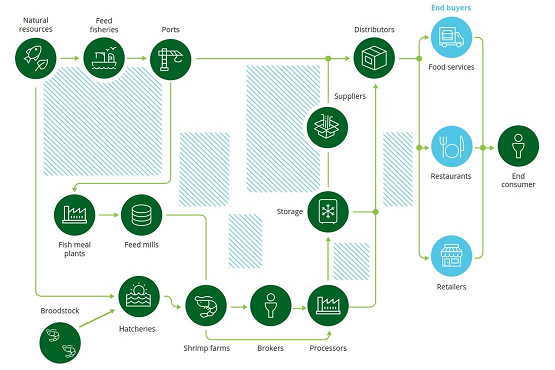
Today’s shrimp supply chains are long, complex, and often opaque. Without visibility, it is impossible to handle food safety concerns, prove legality, and verify sustainability—all issues that consumers, investors, regulators, and media are increasingly demanding. Traceability is essential to demonstrating that a product is ethically and sustainably sourced.
https://seafoodsustainability.org/aquaculture/farmed-shrimp/traceability/
Today’s shrimp supply chains are long, complex, and often opaque. Without visibility, it is impossible to handle food safety concerns, prove legality, and verify sustainability—all issues that consumers, investors, regulators, and media are increasingly demanding. Traceability is essential to demonstrating that a product is ethically and sustainably sourced.
EU legislation to encourage sustainable supply chains
https://www.ser.nl/en/Publications/sustainable-supply-chains
The Social and Economic Council of the Netherlands (SER) has advised the Dutch government on how to shape EU legislation on international Responsible Business Conduct (RBC). A European approach should focus on improving the conditions for people and the environment across supply chains. To have maximum impact on international supply chains outside the EU, the legislation should incentivise European cooperation at sector level.
https://www.ser.nl/en/Publications/sustainable-supply-chains
The Social and Economic Council of the Netherlands (SER) has advised the Dutch government on how to shape EU legislation on international Responsible Business Conduct (RBC). A European approach should focus on improving the conditions for people and the environment across supply chains. To have maximum impact on international supply chains outside the EU, the legislation should incentivise European cooperation at sector level.
Raodsides journal 7: #Logistics
https://roadsides.net/collection-no-007/
With this issue of Roadsides, we will take a closer look at the various disappearing acts and occasional spectacles of logistics. Typically, logistics figures only as a secondary dimension of infrastructure in its mundane register as “the study of boring things” (Star 1999). As a managerial science for designing the operative logics of “flow” through various infrastructures (e.g., trade, migration, data), logistics also appears as the handmaiden to the distinct movements it mediates. For instance, until recently, the logistics of commodity flows have been largely understudied in the social science of market economies, as most studies have focused either on production or consumption as an organizing economic trope. Similarly, research investigating the flows of migration or data infrastructures tend to sideline logistics as something not worthy of serious analysis, if they recognize it at all.
https://roadsides.net/collection-no-007/
With this issue of Roadsides, we will take a closer look at the various disappearing acts and occasional spectacles of logistics. Typically, logistics figures only as a secondary dimension of infrastructure in its mundane register as “the study of boring things” (Star 1999). As a managerial science for designing the operative logics of “flow” through various infrastructures (e.g., trade, migration, data), logistics also appears as the handmaiden to the distinct movements it mediates. For instance, until recently, the logistics of commodity flows have been largely understudied in the social science of market economies, as most studies have focused either on production or consumption as an organizing economic trope. Similarly, research investigating the flows of migration or data infrastructures tend to sideline logistics as something not worthy of serious analysis, if they recognize it at all.
The Supply Chain Crisis Is About to Get a Lot Worse
https://www.wired.com/story/supply-chain-crisis-data/
A seemingly endless supply chain crunch has fueled interest in tech that promises to track problems or predict where new ones might occur.
https://www.wired.com/story/supply-chain-crisis-data/
A seemingly endless supply chain crunch has fueled interest in tech that promises to track problems or predict where new ones might occur.
The impact of improved traceability on the safety of food
https://www.lrfoundation.org.uk/en/news/impact-traceability-food-safety/
In a new report RS Standards have reviewed the impact of improved traceability on the safety of food, looking at current initiatives that could provide a basis for a roadmap for future developments.
https://www.lrfoundation.org.uk/en/news/impact-traceability-food-safety/
In a new report RS Standards have reviewed the impact of improved traceability on the safety of food, looking at current initiatives that could provide a basis for a roadmap for future developments.