Home
| About
| Mine Tracker
| RSS
| Next page
| Footer
▄▄▄▄▄▄▄▄▄▄▄▄▄▄▄▄▄▄▄▄▄▄▄▄▄▄▄▄▄▄▄▄▄▄▄▄▄▄▄▄▄▄▄▄▄▄▄▄▄▄▄▄▄▄▄▄▄▄▄▄▄▄▄▄▄▄▄▄▄▄▄▄▄▄▄▄▄▄▄▄▄▄▄▄▄▄▄▄▄▄▄▄▄▄▄▄
█▄▄░▄▄█░▄▄▀█░▄▄▀█▀▄▀█░▄▄███░▄▄▀█░▄▄▀█░▄▀███▄▄░▄▄█░▄▄▀█░▄▄▀█▀▄▀█░▄▄█░▄▄▀█░▄▄▀██▄██░███▄██▄░▄█░██░
███░███░▀▀▄█░▀▀░█░█▀█░▄▄███░▀▀░█░██░█░█░█████░███░▀▀▄█░▀▀░█░█▀█░▄▄█░▀▀░█░▄▄▀██░▄█░███░▄██░██░▀▀░
███░███▄█▄▄█▄██▄██▄██▄▄▄███▄██▄█▄██▄█▄▄██████░███▄█▄▄█▄██▄██▄██▄▄▄█▄██▄█▄▄▄▄█▄▄▄█▄▄█▄▄▄██▄██▀▀▀▄
▀▀▀▀▀▀▀▀▀▀▀▀▀▀▀▀▀▀▀▀▀▀▀▀▀▀▀▀▀▀▀▀▀▀▀▀▀▀▀▀▀▀▀▀▀▀▀▀▀▀▀▀▀▀▀▀▀▀▀▀▀▀▀▀▀▀▀▀▀▀▀▀▀▀▀▀▀▀▀▀▀▀▀▀▀▀▀▀▀▀▀▀▀▀▀▀
PDF; Towards a Digital Product Passport Fit for Contributing to a Circular Economy
https://www.mdpi.com/1996-1073/14/8/2289
The Digital Product Passport (DPP) is a concept of a policy instrument particularly pushed by policy circles to contribute to a circular economy. The preliminary design of the DPP is supposed to have product-related information compiled mainly by manufactures and, thus, to provide the basis for more circular products. Given the lack of scientific debate on the DPP, this study seeks to work out design options of the DPP and how these options might benefit stakeholders in a product’s value chain.
https://www.mdpi.com/1996-1073/14/8/2289
The Digital Product Passport (DPP) is a concept of a policy instrument particularly pushed by policy circles to contribute to a circular economy. The preliminary design of the DPP is supposed to have product-related information compiled mainly by manufactures and, thus, to provide the basis for more circular products. Given the lack of scientific debate on the DPP, this study seeks to work out design options of the DPP and how these options might benefit stakeholders in a product’s value chain.
Article: A proposed universal definition of a Digital Product Passport Ecosystem (DPPE): Worldviews,
https://www.sciencedirect.com/science/article/pii/S0959652622051125
This paper contributes new knowledge and understanding about the role that Product Passports might play in advancing sustainable business practices towards a Circular Economy. The significance of this research is the proposed universal definition of a Digital Product Passport Ecosystem (DPPE) for international policy, industrial and technical communities. The novelty of this research lies in the systems thinking approach, coupled with systems engineering, to define and model a DPPE as a System of Systems to derive a definition. Stakeholder perspectives and requirements concerning Product Passports were synthesised using data and analysis from the European Commission's (EC) open consultation on the Sustainable Products Initiative (SPI). Nine high-level capabilities of a DPPE have been identified, and each is explored by mapping a list of information requirements discussed within the consultation. It is shown that different Product Passport applications benefit (or detriment) different stakeholder groups.
https://www.sciencedirect.com/science/article/pii/S0959652622051125
This paper contributes new knowledge and understanding about the role that Product Passports might play in advancing sustainable business practices towards a Circular Economy. The significance of this research is the proposed universal definition of a Digital Product Passport Ecosystem (DPPE) for international policy, industrial and technical communities. The novelty of this research lies in the systems thinking approach, coupled with systems engineering, to define and model a DPPE as a System of Systems to derive a definition. Stakeholder perspectives and requirements concerning Product Passports were synthesised using data and analysis from the European Commission's (EC) open consultation on the Sustainable Products Initiative (SPI). Nine high-level capabilities of a DPPE have been identified, and each is explored by mapping a list of information requirements discussed within the consultation. It is shown that different Product Passport applications benefit (or detriment) different stakeholder groups.
CIRPASS; Digital Product Passport
https://cirpassproject.eu
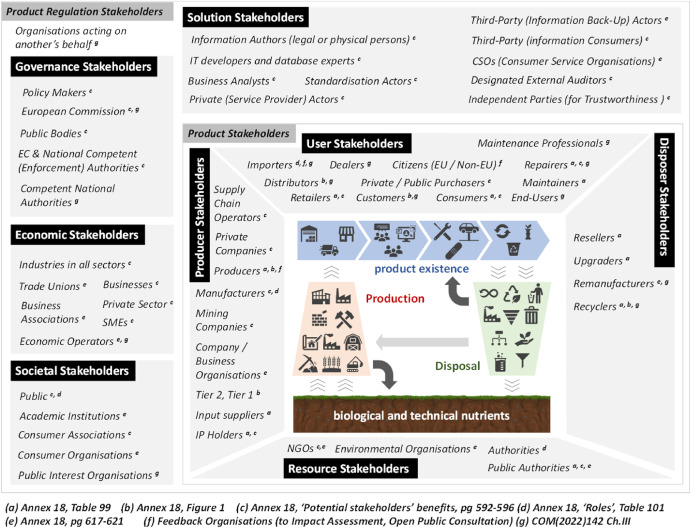
A Digital Product Passport (DPP) is a structured collection of product related data with pre- defined scope and agreed data ownership and access rights conveyed through a unique identifier and that is accessible via electronic means through a data carrier. The intended scope of the DPP is information related to sustainability, circularity, value retention for re- use, remanufacturing, and recycling.
The DPP’s goals are: (1) enhancing sustainable production; (2) extending product lifetimes, optimising product use, and providing new business opportunities to economic actors through circular value retention and extraction; (3) supporting consumers in making sustainable choices; (4) enabling the transition to the circular economy by boosting materials and energy efficiency; and (5) supporting authorities to verify compliance. (European Commission).
https://cirpassproject.eu
A Digital Product Passport (DPP) is a structured collection of product related data with pre- defined scope and agreed data ownership and access rights conveyed through a unique identifier and that is accessible via electronic means through a data carrier. The intended scope of the DPP is information related to sustainability, circularity, value retention for re- use, remanufacturing, and recycling.
The DPP’s goals are: (1) enhancing sustainable production; (2) extending product lifetimes, optimising product use, and providing new business opportunities to economic actors through circular value retention and extraction; (3) supporting consumers in making sustainable choices; (4) enabling the transition to the circular economy by boosting materials and energy efficiency; and (5) supporting authorities to verify compliance. (European Commission).
Digital Product Passport (DPP)
https://www.digimarc.com/blog/decentralized-blueprint-digital-product-passports
The European Commission announced at the end of March 2022 its intention to make Digital Products Passports mandatory as soon as 2024 at least for all product categories regulated under the Ecodesign for Sustainable Products Regulation. Additional delegated acts issued by the EU specify the Digital Product Passport requirements for specific product categories (e.g. starting with Electric Vehicle batteries, textiles, construction materials, consumer electronics, packaging, food). The aim of these passports is to track, process, and share information to make consumer products longer-lasting, easier to repair and recycle, and cleaner in terms of usage of environmentally-friendly materials, enhancing the overall environmental sustainability of products placed on the European market.
https://www.digimarc.com/blog/decentralized-blueprint-digital-product-passports
The European Commission announced at the end of March 2022 its intention to make Digital Products Passports mandatory as soon as 2024 at least for all product categories regulated under the Ecodesign for Sustainable Products Regulation. Additional delegated acts issued by the EU specify the Digital Product Passport requirements for specific product categories (e.g. starting with Electric Vehicle batteries, textiles, construction materials, consumer electronics, packaging, food). The aim of these passports is to track, process, and share information to make consumer products longer-lasting, easier to repair and recycle, and cleaner in terms of usage of environmentally-friendly materials, enhancing the overall environmental sustainability of products placed on the European market.
PDF; Turbulent Circulation
https://eprints.soas.ac.uk/26197/3/Introduction%20-%202018.05.23%20revised%20for%20EPD.pdf
Since the mid-20th century, logistics has evolved into a wide-ranging science of circulation involved in planning and managing flows of innumerable kinds. In this introductory essay, we take stock of the ascendancy and proliferation of logistics, proposing a critical engagement with the field. We argue that logistics is not limited to the management of supply chains, military or corporate. Rather, it is better understood as a calculative logic and spatial practice of circulation that is at the fore of the reorganization of capitalism and war. Viewed from this perspective, the rise of logistics has transformed not only the physical movement of materials but also the very rationality by which space is organized. It has remade economic and military space according to a universalizing logic of abstract flow, exacerbating existing patterns of uneven geographical development.
https://eprints.soas.ac.uk/26197/3/Introduction%20-%202018.05.23%20revised%20for%20EPD.pdf
Since the mid-20th century, logistics has evolved into a wide-ranging science of circulation involved in planning and managing flows of innumerable kinds. In this introductory essay, we take stock of the ascendancy and proliferation of logistics, proposing a critical engagement with the field. We argue that logistics is not limited to the management of supply chains, military or corporate. Rather, it is better understood as a calculative logic and spatial practice of circulation that is at the fore of the reorganization of capitalism and war. Viewed from this perspective, the rise of logistics has transformed not only the physical movement of materials but also the very rationality by which space is organized. It has remade economic and military space according to a universalizing logic of abstract flow, exacerbating existing patterns of uneven geographical development.
PDF; Short Circuit the Counter Logistics reader
https://desarquivo.org/sites/default/files/short_circuit_a_counterlogistics_reader.pdf
Counter-logistics is not simply a matter of blocking all flows, of stopping movement, of locking things in place where they are. It is a matter of blocking those flows that constitute the material and metaphysical tissue of this world, while simultaneously enhancing our own ethical connections, movement, and friendship. Helping migrants to cross borders and remain undetected, helping information to cross through and within prison walls, destroying surveillance cameras, defending the basis of new worlds seized in opposition to the old—these are as important as blocking rail lines and disrupting commerce
https://desarquivo.org/sites/default/files/short_circuit_a_counterlogistics_reader.pdf
Counter-logistics is not simply a matter of blocking all flows, of stopping movement, of locking things in place where they are. It is a matter of blocking those flows that constitute the material and metaphysical tissue of this world, while simultaneously enhancing our own ethical connections, movement, and friendship. Helping migrants to cross borders and remain undetected, helping information to cross through and within prison walls, destroying surveillance cameras, defending the basis of new worlds seized in opposition to the old—these are as important as blocking rail lines and disrupting commerce
Article; Shipping Doesn’t Do What Everyone Says it Does
https://weirdeconomies.com/contributions/producing-circulation
One way that we’ve been thinking about logistics recently is as a project of time management, at planetary scale. Logistics seems to no longer be the annihilation of space by time, but the management of time (or contingency, or money) through the perceived capacity to manipulate space — bigger ships, more containers, and bigger ports to accommodate them. But as it becomes harder and harder to sustain the promise of things moved quickly, the whole thing begins to collapse. One question that lies at the forefront of much recent attention to supply chains and commodity flows is, ‘can the current map of financial flows survive a remapping of the world’s shipping system?’. A more pragmatic question might be whether the shipping system can survive its own financially-minded, oligopolistic death drive — or even, in its current bloated state, if it should. Virilio famously said that the invention of the ship is the invention of the shipwreck. To return to where we started, now it seems as though the mass shipwreck is the inauguration of shipping’s weird new era.
https://weirdeconomies.com/contributions/producing-circulation
One way that we’ve been thinking about logistics recently is as a project of time management, at planetary scale. Logistics seems to no longer be the annihilation of space by time, but the management of time (or contingency, or money) through the perceived capacity to manipulate space — bigger ships, more containers, and bigger ports to accommodate them. But as it becomes harder and harder to sustain the promise of things moved quickly, the whole thing begins to collapse. One question that lies at the forefront of much recent attention to supply chains and commodity flows is, ‘can the current map of financial flows survive a remapping of the world’s shipping system?’. A more pragmatic question might be whether the shipping system can survive its own financially-minded, oligopolistic death drive — or even, in its current bloated state, if it should. Virilio famously said that the invention of the ship is the invention of the shipwreck. To return to where we started, now it seems as though the mass shipwreck is the inauguration of shipping’s weird new era.
Article; Logistics, Counterlogistics and the Communist Prospect
https://endnotes.org.uk/articles/logistics-counterlogistics-and-the-communist-prospect
Today’s supply chains are distinguished not just by their planetary extension and incredible speed but by their direct integration of manufacture and retail, their harmonisation of the rhythms of production and consumption. Since the 1980s, business writers have touted the value of “lean” and “flexible” production models, in which suppliers maintain the capacity to expand and contract production, as well as change the types of commodities produced, by relying on a network of subcontractors, temporary workers, and mutable organisational structures, adaptations that require precise control over the flow of goods and information between units. Originally associated with the Toyota Production System, and Japanese manufacturers in general, these corporate forms are now frequently identified with the loose moniker Just In Time (JIT), which refers in the specific sense to a form of inventory management and in general to a production philosophy in which firms aim to eliminate standing inventory (whether produced in-house or received from suppliers). Derived in part from the Japanese and in part from Anglo-American cybernetics, JIT is a circulationist production philosophy, oriented around a concept of “continuous flow” that views everything not in motion as a form of waste (muda), a drag on profits. JIT aims to submit all production to the condition of circulation, pushing its velocity as far toward the light-speed of information transmission as possible. From the perspective of our blockaders, this emphasis on the quick and continuous flow of commodities multiplies the power of the blockade. In the absence of standing inventories, a blockade of just a few days could effectively paralyse many manufacturers and retailers.
https://endnotes.org.uk/articles/logistics-counterlogistics-and-the-communist-prospect
Today’s supply chains are distinguished not just by their planetary extension and incredible speed but by their direct integration of manufacture and retail, their harmonisation of the rhythms of production and consumption. Since the 1980s, business writers have touted the value of “lean” and “flexible” production models, in which suppliers maintain the capacity to expand and contract production, as well as change the types of commodities produced, by relying on a network of subcontractors, temporary workers, and mutable organisational structures, adaptations that require precise control over the flow of goods and information between units. Originally associated with the Toyota Production System, and Japanese manufacturers in general, these corporate forms are now frequently identified with the loose moniker Just In Time (JIT), which refers in the specific sense to a form of inventory management and in general to a production philosophy in which firms aim to eliminate standing inventory (whether produced in-house or received from suppliers). Derived in part from the Japanese and in part from Anglo-American cybernetics, JIT is a circulationist production philosophy, oriented around a concept of “continuous flow” that views everything not in motion as a form of waste (muda), a drag on profits. JIT aims to submit all production to the condition of circulation, pushing its velocity as far toward the light-speed of information transmission as possible. From the perspective of our blockaders, this emphasis on the quick and continuous flow of commodities multiplies the power of the blockade. In the absence of standing inventories, a blockade of just a few days could effectively paralyse many manufacturers and retailers.
Article: Net Zero Shipping
https://www.ship-technology.com/features/net-zero-shipping-where-theres-a-will/
Shipping emissions come down to four factors: the weight of goods transported, the distance they cover, the amount of fuel it takes for one tonne of products to move 1km, and the amount of the carbon released through the production and use of that fuel – known as the fuel’s “carbon intensity”. Although battery electric ships are in development for short-distance shipping, the overwhelming focus for decarbonising the sector as a whole comes down to that last point – the type of fuel used and its carbon intensity. The problem is, zero-emissions fuels like green hydrogen and ammonia have yet to enter the fuel supply and are not expected to be produced in sufficient quantities to grow past the single-digit percentage mark before 2030 at the earliest.
https://www.ship-technology.com/features/net-zero-shipping-where-theres-a-will/
Shipping emissions come down to four factors: the weight of goods transported, the distance they cover, the amount of fuel it takes for one tonne of products to move 1km, and the amount of the carbon released through the production and use of that fuel – known as the fuel’s “carbon intensity”. Although battery electric ships are in development for short-distance shipping, the overwhelming focus for decarbonising the sector as a whole comes down to that last point – the type of fuel used and its carbon intensity. The problem is, zero-emissions fuels like green hydrogen and ammonia have yet to enter the fuel supply and are not expected to be produced in sufficient quantities to grow past the single-digit percentage mark before 2030 at the earliest.
Orca AI; Company Website
https://www.orca-ai.io/
With the first automated situational awareness platform, you can now make informed decisions on board and on shore to ensure voyage safety and operational efficiency
https://www.orca-ai.io/
With the first automated situational awareness platform, you can now make informed decisions on board and on shore to ensure voyage safety and operational efficiency
Tooze: Gold Mining in Africa
https://adamtooze.substack.com/p/chartbook-209-the-sudan-crisis-and

The activities of Africa’s artisanal miners have attracted media coverage around the world. This tends to concentrate on the primitive conditions in which they work. Dramatic pictures of artisanal mining conjure up comparisons to the “19th century” or some other imagined past. Frequently comments are made about the stark contrast between the smartphones that the rare earths end up in and the primitivism of the conditions in which gold, coltan etc are mined.
The contrast between affluence and poverty is only too real. But the idea that they reflect different eras of history, or different stages of development is an illusion.
The activity of artisanal mining is quite new in most of the places in Africa that have been caught up in the current resource boom. It has certainly never been practice on this scale before. Giant artisanal mine sites in Mali or Darfur are no more more natural or native to Africa than the deforested cocoa regions of CdI. Furthermore, all this activity involving millions of people organized across huge distance, would not be possible without the extensive use of modern technologies at the African sites of production. In 2018 Mali registered 150 cellphone subscriptions per 100 inhabitants and rising. But there is one gizmo of which the Sahel’s gold miners can claim to be the most important users worldwide - the cheap portable metal detectors, which became widely available in the region around 2008-2009.
By 2009 the Sahelian demand for metal-detectors was so intense that it produced a global shortage of the equipment, with order books backed up for 6-9 months, and Chinese imitators scrambling to steal technology from Western market leaders. At one point the British army in Afghanistan blamed its lack of mine detectors on the African mining boom.
https://adamtooze.substack.com/p/chartbook-209-the-sudan-crisis-and
The activities of Africa’s artisanal miners have attracted media coverage around the world. This tends to concentrate on the primitive conditions in which they work. Dramatic pictures of artisanal mining conjure up comparisons to the “19th century” or some other imagined past. Frequently comments are made about the stark contrast between the smartphones that the rare earths end up in and the primitivism of the conditions in which gold, coltan etc are mined.
The contrast between affluence and poverty is only too real. But the idea that they reflect different eras of history, or different stages of development is an illusion.
The activity of artisanal mining is quite new in most of the places in Africa that have been caught up in the current resource boom. It has certainly never been practice on this scale before. Giant artisanal mine sites in Mali or Darfur are no more more natural or native to Africa than the deforested cocoa regions of CdI. Furthermore, all this activity involving millions of people organized across huge distance, would not be possible without the extensive use of modern technologies at the African sites of production. In 2018 Mali registered 150 cellphone subscriptions per 100 inhabitants and rising. But there is one gizmo of which the Sahel’s gold miners can claim to be the most important users worldwide - the cheap portable metal detectors, which became widely available in the region around 2008-2009.
By 2009 the Sahelian demand for metal-detectors was so intense that it produced a global shortage of the equipment, with order books backed up for 6-9 months, and Chinese imitators scrambling to steal technology from Western market leaders. At one point the British army in Afghanistan blamed its lack of mine detectors on the African mining boom.
Apple commitment on recycled rare metals
https://www.apple.com/newsroom/2023/04/apple-will-use-100-percent-recycled-cobalt-in-batteries-by-2025/

Apple today announced a major acceleration of its work to expand recycled materials across its products, including a new 2025 target to use 100 percent recycled cobalt1 in all Apple-designed batteries. Additionally, by 2025, magnets in Apple devices will use entirely recycled rare earth elements, and all Apple-designed printed circuit boards will use 100 percent recycled tin soldering and 100 percent recycled gold plating.
https://www.apple.com/newsroom/2023/04/apple-will-use-100-percent-recycled-cobalt-in-batteries-by-2025/
Apple today announced a major acceleration of its work to expand recycled materials across its products, including a new 2025 target to use 100 percent recycled cobalt1 in all Apple-designed batteries. Additionally, by 2025, magnets in Apple devices will use entirely recycled rare earth elements, and all Apple-designed printed circuit boards will use 100 percent recycled tin soldering and 100 percent recycled gold plating.
Say NO to LNG
https://saynotolng.org/
Say No To LNG is a global shipping campaign aimed at debunking the myth that LNG is a “climate friendly” marine fuel alternative and exposing the true nature of LNG as the fossil fuel.
https://saynotolng.org/
Say No To LNG is a global shipping campaign aimed at debunking the myth that LNG is a “climate friendly” marine fuel alternative and exposing the true nature of LNG as the fossil fuel.
Ports for People
https://portsforpeople.pacificenvironment.org/
Clean ships, healthy futures. Together with local communities, allies and partners, Ports for People seeks to transform ports from hotspots of fossil fuel pollution to thriving hubs of sustainable economic development and environmental protection.
https://portsforpeople.pacificenvironment.org/
Clean ships, healthy futures. Together with local communities, allies and partners, Ports for People seeks to transform ports from hotspots of fossil fuel pollution to thriving hubs of sustainable economic development and environmental protection.
Dutch Textile Trade Project
https://dutchtextiletrade.org/
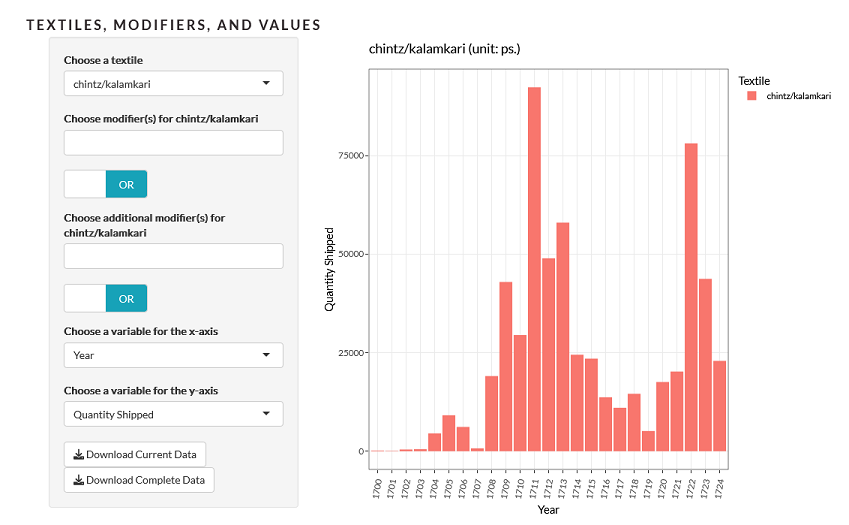
This project aims to understand the circulation of textiles on Dutch ships around the world in the seventeenth and eighteenth century, by examining data drawn from trade records alongside samples of textiles and visual culture depicting the use of textiles. The Visual Textile Glossary is our centerpiece, providing each historical textile term with a short definition and a longer essay contextualizing that textile’s production and circulation, with visual and material examples, and you can explore and download the relevant data.
https://dutchtextiletrade.org/
This project aims to understand the circulation of textiles on Dutch ships around the world in the seventeenth and eighteenth century, by examining data drawn from trade records alongside samples of textiles and visual culture depicting the use of textiles. The Visual Textile Glossary is our centerpiece, providing each historical textile term with a short definition and a longer essay contextualizing that textile’s production and circulation, with visual and material examples, and you can explore and download the relevant data.
Article: Can Cybersocialist Planning Become a Reality?
https://jacobin.com/2023/04/cybersocialism-economic-planning-marxism-information-theory-econophysics
The digital revolution of recent decades allows for much more developed resource allocation than was possible in the 20th century. Cybersocialist planning, some argue, can provide for a rational allocation of resources, under real democratic control.
https://jacobin.com/2023/04/cybersocialism-economic-planning-marxism-information-theory-econophysics
The digital revolution of recent decades allows for much more developed resource allocation than was possible in the 20th century. Cybersocialist planning, some argue, can provide for a rational allocation of resources, under real democratic control.
Article: Cybernetics of the Future
https://cosmonautmag.com/2022/07/glushkov-and-his-ideas-cybernetics-of-the-future-by-vasiliy-pikhorovich/
As capitalist waste leads to more and more obviously ecological devastation, we communists must be louder in proclaiming that another world is possible. Opposed to the anarchy of the market is the idea of a planned economy, and more specifically a socialist one. The centennial objection to planning is that it is impossible to plan something as complex as the economy that results from millions of agents making billions of transactions. However, with computers that are becoming smarter every day and increasingly capable of solving some of the most complex problems in the world, why should economic planning be excluded from these advances?
https://cosmonautmag.com/2022/07/glushkov-and-his-ideas-cybernetics-of-the-future-by-vasiliy-pikhorovich/
As capitalist waste leads to more and more obviously ecological devastation, we communists must be louder in proclaiming that another world is possible. Opposed to the anarchy of the market is the idea of a planned economy, and more specifically a socialist one. The centennial objection to planning is that it is impossible to plan something as complex as the economy that results from millions of agents making billions of transactions. However, with computers that are becoming smarter every day and increasingly capable of solving some of the most complex problems in the world, why should economic planning be excluded from these advances?
Article: Big Business games the supply chain
https://prospect.org/economy/big-business-games-the-supply-chain/
Big-box stores, however, have circumvented many of the bottlenecks. Amazon, Walmart, and other giants have maintained their inventory by expanding logistics operations and striking deals with suppliers, allowing them to get products quicker and cheaper than their smaller rivals. Though the maneuvers keep consumers happy, small businesses have suffered: They wait longer for goods, pay more for shipping, and lose business as customers flock to big-box stores.
https://prospect.org/economy/big-business-games-the-supply-chain/
Big-box stores, however, have circumvented many of the bottlenecks. Amazon, Walmart, and other giants have maintained their inventory by expanding logistics operations and striking deals with suppliers, allowing them to get products quicker and cheaper than their smaller rivals. Though the maneuvers keep consumers happy, small businesses have suffered: They wait longer for goods, pay more for shipping, and lose business as customers flock to big-box stores.
Article: Hidden costs of containerization
https://prospect.org/economy/hidden-costs-of-containerization/
It’s no exaggeration to say that the rise of the shipping container revolutionized the global economy. The abundance of plentiful and cheap goods we have become accustomed to finding at our local Walmart would not exist without the shipping container. Containerization drastically reduced the expense of international trade and increased the speed at which goods are delivered. Today, more than 60 percent of the world’s consumer goods, nearly $14 trillion worth of everything from iPhones to Chiquita bananas, are transported this way. Practically everything we own, will own, or ever want to own has been and will be shipped in a container.
https://prospect.org/economy/hidden-costs-of-containerization/
It’s no exaggeration to say that the rise of the shipping container revolutionized the global economy. The abundance of plentiful and cheap goods we have become accustomed to finding at our local Walmart would not exist without the shipping container. Containerization drastically reduced the expense of international trade and increased the speed at which goods are delivered. Today, more than 60 percent of the world’s consumer goods, nearly $14 trillion worth of everything from iPhones to Chiquita bananas, are transported this way. Practically everything we own, will own, or ever want to own has been and will be shipped in a container.
Glencore, Responsible sourcing and supply
https://www.glencore.com/sustainability/esg-a-z/responsible-sourcing-and-supply
Our Purpose as a company is to responsibly source the commodities that advance everyday life. Responsible sourcing is our commitment to take into account social, ethical and environmental considerations with regards to our products and supply chains and when managing our relationships with suppliers.
https://www.glencore.com/sustainability/esg-a-z/responsible-sourcing-and-supply
Our Purpose as a company is to responsibly source the commodities that advance everyday life. Responsible sourcing is our commitment to take into account social, ethical and environmental considerations with regards to our products and supply chains and when managing our relationships with suppliers.
The Global Battery Alliance (GBA)
https://www.globalbattery.org/
The GBA brings together leading international organizations, NGOs, industry actors, academics and multiple governments to align collectively in a pre-competitive approach, to drive systemic change along the entire value chain. Incubated by the World Economic Forum in 2017 until its independence in 2021, members of the Alliance collaborate to achieve the goals set out in the GBA 2030 Vision and agree to the Ten GBA Guiding Principles. The GBA’s multi-stakeholder governance structure aims to ensure inclusivity in decision-making and strategic focus. Action Partnerships provide a collaborative platform for members to pool their expertise to achieve the shared goals of circularity, environmental protection and sustainable development.
https://www.globalbattery.org/
The GBA brings together leading international organizations, NGOs, industry actors, academics and multiple governments to align collectively in a pre-competitive approach, to drive systemic change along the entire value chain. Incubated by the World Economic Forum in 2017 until its independence in 2021, members of the Alliance collaborate to achieve the goals set out in the GBA 2030 Vision and agree to the Ten GBA Guiding Principles. The GBA’s multi-stakeholder governance structure aims to ensure inclusivity in decision-making and strategic focus. Action Partnerships provide a collaborative platform for members to pool their expertise to achieve the shared goals of circularity, environmental protection and sustainable development.
OECD Due Diligence Guidance for Responsible Supply Chains of Minerals from Conflict-Affected and Hig
https://www.oecd.org/corporate/mne/mining.htm
The OECD Due Diligence Guidance provides detailed recommendations to help companies respect human rights and avoid contributing to conflict through their mineral purchasing decisions and practices. This Guidance is for use by any company potentially sourcing minerals or metals from conflict-affected and high-risk areas. The OECD Guidance is global in scope and applies to all mineral supply chains.
https://www.oecd.org/corporate/mne/mining.htm
The OECD Due Diligence Guidance provides detailed recommendations to help companies respect human rights and avoid contributing to conflict through their mineral purchasing decisions and practices. This Guidance is for use by any company potentially sourcing minerals or metals from conflict-affected and high-risk areas. The OECD Guidance is global in scope and applies to all mineral supply chains.
Re-Source; Company Website
https://re-source.tech/
A digital platform for the traceability of minerals, enabling sustainable supply chains. Powered by blockchain technology, ReSource is a digital platform for the minerals’ supply chains — from the mine to electric-vehicle batteries and beyond.
https://re-source.tech/
A digital platform for the traceability of minerals, enabling sustainable supply chains. Powered by blockchain technology, ReSource is a digital platform for the minerals’ supply chains — from the mine to electric-vehicle batteries and beyond.
Philip Morris,Sustainable Supply Chain
https://www.pmi.com/sustainability/integrated-report-2020-digital

2020 report
https://www.pmi.com/sustainability/integrated-report-2020-digital
2020 report
UNCTAD Open Data: Container port throughput, annual
https://unctadstat.unctad.org/wds/TableViewer/tableView.aspx?ReportId=13321
https://unctadstat.unctad.org/wds/TableViewer/tableView.aspx?ReportId=13321
Lloyd’s List’s One Hundred Ports
https://lloydslist.maritimeintelligence.informa.com/one-hundred-container-ports-2020/port-data

Lloyd’s List’s One Hundred Ports online tool allows users to compare and contrast port rankings, view regional and national statistics, as well as historical teu data.
https://lloydslist.maritimeintelligence.informa.com/one-hundred-container-ports-2020/port-data
Lloyd’s List’s One Hundred Ports online tool allows users to compare and contrast port rankings, view regional and national statistics, as well as historical teu data.
RTB, Real-Time Bidding (the add supply chain)
https://www.iccl.ie/rtb/

The online advertising's Real-Time Bidding (RTB)is the biggest data breach ever recorded. It tracks and shares what people view online and their real-world location with countless companies. This happens 178 Trillion times every year in U.S. & Europe.
https://www.iccl.ie/rtb/
The online advertising's Real-Time Bidding (RTB)is the biggest data breach ever recorded. It tracks and shares what people view online and their real-world location with countless companies. This happens 178 Trillion times every year in U.S. & Europe.
Content Taxonomy 3.0
https://iabtechlab.com/standards/content-taxonomy/
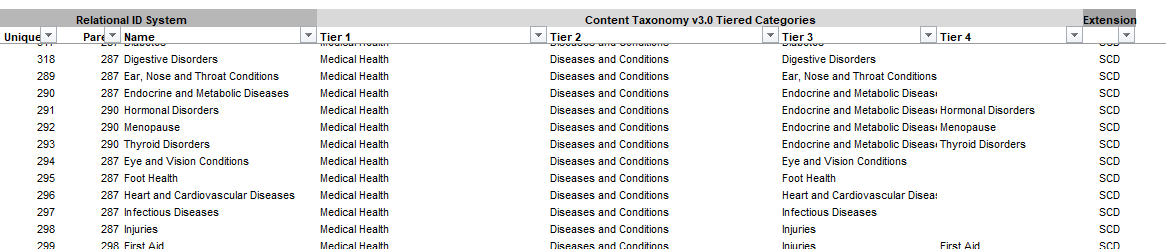
The Content Taxonomy provides a “common language” that can be used when describing content. Typical uses of the content taxonomy are contextual targeting and brand safety.
https://iabtechlab.com/standards/content-taxonomy/
The Content Taxonomy provides a “common language” that can be used when describing content. Typical uses of the content taxonomy are contextual targeting and brand safety.
Beer Game, Supply Chain Game
https://en.wikipedia.org/wiki/Beer_distribution_game

The beer distribution game (also known as the beer game) is an educational game that is used to experience typical coordination problems of a supply chain process. It reflects a role-play simulation where several participants play with each other. The game represents a supply chain with a non-coordinated process where problems arise due to lack of information sharing.
https://en.wikipedia.org/wiki/Beer_distribution_game
The beer distribution game (also known as the beer game) is an educational game that is used to experience typical coordination problems of a supply chain process. It reflects a role-play simulation where several participants play with each other. The game represents a supply chain with a non-coordinated process where problems arise due to lack of information sharing.
Bon Jovi and the Dock Worker
https://www.overthinkingit.com/2009/07/10/bon-jovi-livin-on-a-prayer/
Bon Jovi is “working for the man” indeed. While, at first glance, “Living on a Prayer” seems to be a paean to the working class couples of the world, the text ultimately is meant as an opiate for the masses. It suggests that the poor workers of the world must “hold onto what they’ve got,” rather than rising up against their capitalist oppressors.
https://www.overthinkingit.com/2009/07/10/bon-jovi-livin-on-a-prayer/
Bon Jovi is “working for the man” indeed. While, at first glance, “Living on a Prayer” seems to be a paean to the working class couples of the world, the text ultimately is meant as an opiate for the masses. It suggests that the poor workers of the world must “hold onto what they’ve got,” rather than rising up against their capitalist oppressors.
Fair Cobalt Alliance
https://www.faircobaltalliance.org/
A multi-stakeholder action platform, the Fair Cobalt Alliance offers actors across the cobalt supply chain a pre-competitive environment for collaboration to help strengthen and professionalise DRC’s artisanal cobalt mining sector and contribute to local economic development at large.
https://www.faircobaltalliance.org/
A multi-stakeholder action platform, the Fair Cobalt Alliance offers actors across the cobalt supply chain a pre-competitive environment for collaboration to help strengthen and professionalise DRC’s artisanal cobalt mining sector and contribute to local economic development at large.
Book; The Rare Metals War
https://scribepublications.co.uk/books-authors/books/the-rare-metals-war-9781912854264
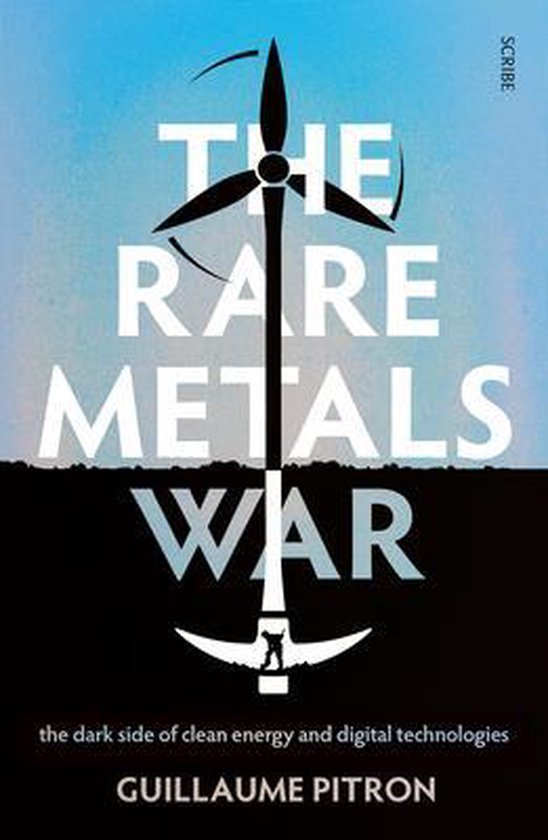
Translated from the French, Guillaume Pitron’s The Rare Metal War (2018) is a blistering journey through the political, strategic and environmental consequences of the world’s need for rare earth minerals to drive the energy transition. China’s strategic manipulation and landgrab of skills, industries and resources is detailed with admiring scorn while the western’s world apathy is considered as a general weakness of capitalism. The book is high on opinion and is meant to pack a punch. There are however also several informative appendices with data and a number of interesting factoids that I enjoyed. This is a activism more than journalism ending with the conclusion that Europe, and France especially, should restart their mining industries and do it to the highest standards; on the argument that clean mines in Europe for metals we use ourselves will prevent unmitigated environmental degradation in less regulated places like China.
https://scribepublications.co.uk/books-authors/books/the-rare-metals-war-9781912854264
Translated from the French, Guillaume Pitron’s The Rare Metal War (2018) is a blistering journey through the political, strategic and environmental consequences of the world’s need for rare earth minerals to drive the energy transition. China’s strategic manipulation and landgrab of skills, industries and resources is detailed with admiring scorn while the western’s world apathy is considered as a general weakness of capitalism. The book is high on opinion and is meant to pack a punch. There are however also several informative appendices with data and a number of interesting factoids that I enjoyed. This is a activism more than journalism ending with the conclusion that Europe, and France especially, should restart their mining industries and do it to the highest standards; on the argument that clean mines in Europe for metals we use ourselves will prevent unmitigated environmental degradation in less regulated places like China.
PwC’s 2023 Digital Trends in Supply Chain Survey
https://www.pwc.com/us/opssurvey
Between an increasingly digital world and persistent operational disruptions, the effective use of technologies in supply chains has become more critical. In addition to lowering costs, improving efficiency and building resilience, digital investments can mitigate risks and address environmental, social and governance (ESG) issues. But as PwC’s 2023 Digital Trends in Supply Chain Survey reveals, many challenges remain, and companies can do more to elevate their supply chains in the digital age.
https://www.pwc.com/us/opssurvey
Between an increasingly digital world and persistent operational disruptions, the effective use of technologies in supply chains has become more critical. In addition to lowering costs, improving efficiency and building resilience, digital investments can mitigate risks and address environmental, social and governance (ESG) issues. But as PwC’s 2023 Digital Trends in Supply Chain Survey reveals, many challenges remain, and companies can do more to elevate their supply chains in the digital age.
KoBold Metals; Company Website
https://www.koboldmetals.com/
Finding the materials of the future with AI KoBold Metals® discovers the materials critical for the electric vehicle and renewable energy revolutions
https://www.koboldmetals.com/
Finding the materials of the future with AI KoBold Metals® discovers the materials critical for the electric vehicle and renewable energy revolutions
Climate and Community Project
https://www.climateandcommunity.org/
The Climate and Community Project (CCP) is a progressive climate policy think tank developing cutting-edge research at the climate and inequality nexus.
https://www.climateandcommunity.org/
The Climate and Community Project (CCP) is a progressive climate policy think tank developing cutting-edge research at the climate and inequality nexus.
From the White House: Building resilient supply chains
https://whitehouse.gov/wp-content/uploads/2021/06/100-day-supply-chain-review-report.pdf

More secure and resilient supply chains are essential for our national security, our economic security, and our technological leadership.
National security experts, including the Department of Defense, have consistently argued that the nation’s underlying commercial industrial foundations are central to our security. Reports from both Republican and Democratic administrations have raised concerns about the defense industry’s reliance on limited domestic suppliers; a global supply chain vulnerable to disruption; and competitor country suppliers. Innovations essential to military preparedness—like highly specialized lithium-ion batteries—require an ecosystem of innovation, skills, and production facilities that the United States currently lacks. The disappearance of domestic production of essential antibiotics impairs our ability to counter threats ranging from pandemics to bio-terrorism, as emphasized by the FDA’s analysis of supply chains for active pharmaceutical ingredients.
Our economic security—steady employment and smooth operations of critical industries—also requires secure and resilient supply chains. For more than a decade, the Department of Defense has consistently found that essential civilian industries would bear the preponderance of harm from a disruption of strategic and critical materials supply. The Department of Energy notes that, today, China refines 60 percent of the world’s lithium and 80 percent of the world’s cobalt, two core inputs to high-capacity batteries—which presents a critical vulnerability to the future of the U.S. domestic auto ind
https://whitehouse.gov/wp-content/uploads/2021/06/100-day-supply-chain-review-report.pdf
More secure and resilient supply chains are essential for our national security, our economic security, and our technological leadership.
National security experts, including the Department of Defense, have consistently argued that the nation’s underlying commercial industrial foundations are central to our security. Reports from both Republican and Democratic administrations have raised concerns about the defense industry’s reliance on limited domestic suppliers; a global supply chain vulnerable to disruption; and competitor country suppliers. Innovations essential to military preparedness—like highly specialized lithium-ion batteries—require an ecosystem of innovation, skills, and production facilities that the United States currently lacks. The disappearance of domestic production of essential antibiotics impairs our ability to counter threats ranging from pandemics to bio-terrorism, as emphasized by the FDA’s analysis of supply chains for active pharmaceutical ingredients.
Our economic security—steady employment and smooth operations of critical industries—also requires secure and resilient supply chains. For more than a decade, the Department of Defense has consistently found that essential civilian industries would bear the preponderance of harm from a disruption of strategic and critical materials supply. The Department of Energy notes that, today, China refines 60 percent of the world’s lithium and 80 percent of the world’s cobalt, two core inputs to high-capacity batteries—which presents a critical vulnerability to the future of the U.S. domestic auto ind
Basel Action Network
https://www.ban.org/
BAN’s mission is to champion global environmental health and justice by ending toxic trade, catalyzing a toxics-free future, and campaigning for everyone’s right to a clean environment.
https://www.ban.org/
BAN’s mission is to champion global environmental health and justice by ending toxic trade, catalyzing a toxics-free future, and campaigning for everyone’s right to a clean environment.
FSMA Final Rule on Requirements for Additional Traceability Records for Certain Foods
https://www.fda.gov/food/food-safety-modernization-act-fsma/fsma-final-rule-requirements-additional-traceability-records-certain-foods
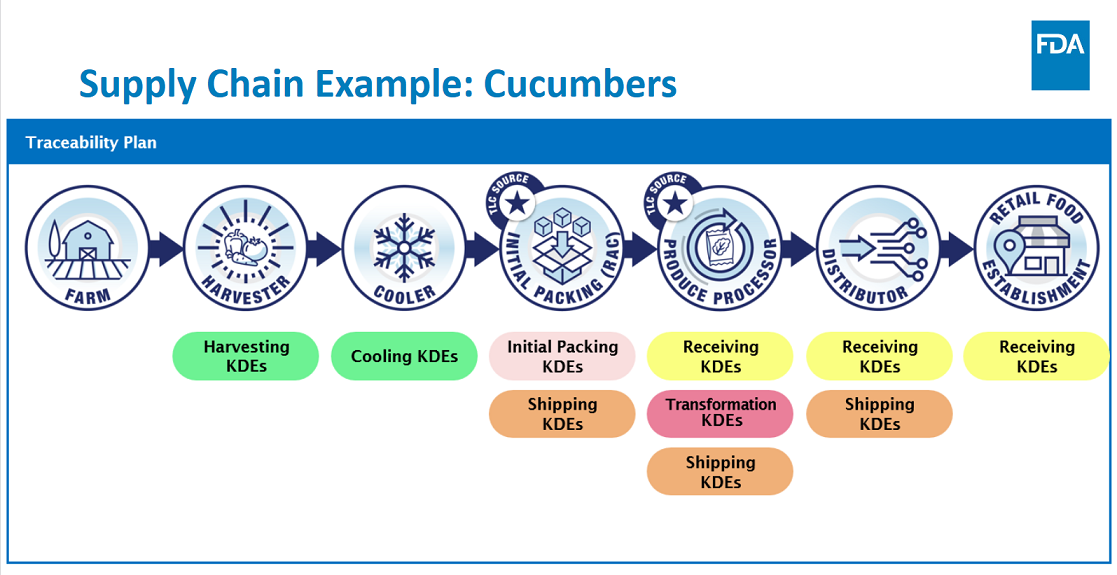
At the core of this rule is a requirement that persons subject to the rule who manufacture, process, pack, or hold foods on the FTL, maintain records containing Key Data Elements (KDEs) associated with specific Critical Tracking Events (CTEs); and provide information to the FDA within 24 hours or within some reasonable time to which the FDA has agreed.
https://www.fda.gov/food/food-safety-modernization-act-fsma/fsma-final-rule-requirements-additional-traceability-records-certain-foods
At the core of this rule is a requirement that persons subject to the rule who manufacture, process, pack, or hold foods on the FTL, maintain records containing Key Data Elements (KDEs) associated with specific Critical Tracking Events (CTEs); and provide information to the FDA within 24 hours or within some reasonable time to which the FDA has agreed.
PDF: the EJAtlas, Mapping the frontiers and front lines of global environmental justice
https://journals.librarypublishing.arizona.edu/jpe/article/1932/galley/2191/view/
This article highlights the need for collaborative research on ecological conflicts within a global perspective. As the social metabolism of our industrial economy increases, intensifying extractive activities and the production of waste, the related social and environmental impacts generate conflicts and resistance across the world. This expansion of global capitalism leads to greater disconnection between the diverse geographies of injustice along commodity chains. Yet, at the same time, through the globalization of governance processes and Environmental Justice (EJ) movements, local political ecologies are becoming increasingly transnational and interconnected.
https://journals.librarypublishing.arizona.edu/jpe/article/1932/galley/2191/view/
This article highlights the need for collaborative research on ecological conflicts within a global perspective. As the social metabolism of our industrial economy increases, intensifying extractive activities and the production of waste, the related social and environmental impacts generate conflicts and resistance across the world. This expansion of global capitalism leads to greater disconnection between the diverse geographies of injustice along commodity chains. Yet, at the same time, through the globalization of governance processes and Environmental Justice (EJ) movements, local political ecologies are becoming increasingly transnational and interconnected.
Environmental Justice Atlas
https://ejatlas.org/

The environmental justice atlas documents and catalogues social conflict around environmental issues. Across the world communities are struggling to defend their land, air, water, forests and their livelihoods from damaging projects and extractive activities with heavy environmental and social impacts: mining, dams, tree plantations, fracking, gas flaring, incinerators, etc. As resources needed to fuel our economy move through the commodity chain from extraction, processing and disposal, at each stage environmental impacts are externalized onto the most marginalized populations. Often this all takes place far from the eyes of concerned citizens or consumers of the end-products.
https://ejatlas.org/
The environmental justice atlas documents and catalogues social conflict around environmental issues. Across the world communities are struggling to defend their land, air, water, forests and their livelihoods from damaging projects and extractive activities with heavy environmental and social impacts: mining, dams, tree plantations, fracking, gas flaring, incinerators, etc. As resources needed to fuel our economy move through the commodity chain from extraction, processing and disposal, at each stage environmental impacts are externalized onto the most marginalized populations. Often this all takes place far from the eyes of concerned citizens or consumers of the end-products.
Tony's Open Chain
https://www.tonysopenchain.com/
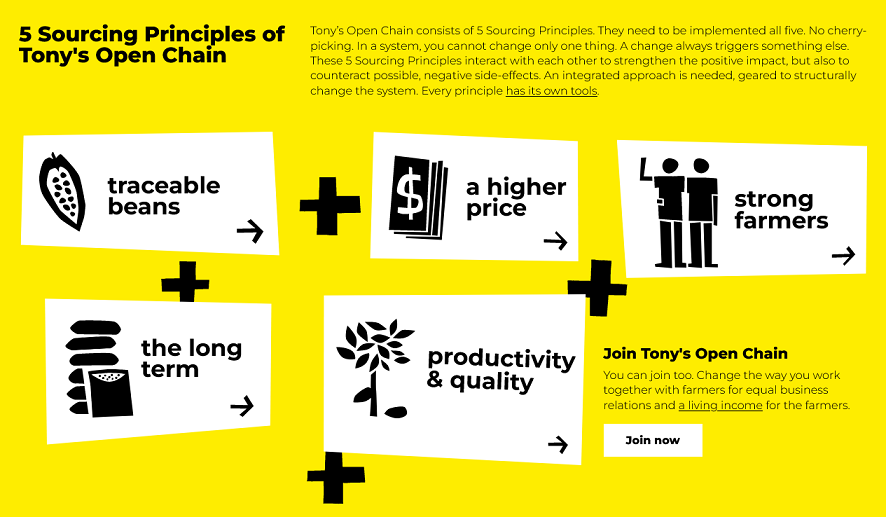
Tony’s Open Chain is an industry-led initiative that helps chocolate brands transform their cocoa supply chains and become sustainability frontrunners.
https://www.tonysopenchain.com/
Tony’s Open Chain is an industry-led initiative that helps chocolate brands transform their cocoa supply chains and become sustainability frontrunners.
LEGO supply Chain
https://www.lego.com/cdn/cs/aboutus/assets/blt75660d26d6a7e08c/LEGO_Global_Supply_Chain_Network.pdf

https://www.lego.com/cdn/cs/aboutus/assets/blt75660d26d6a7e08c/LEGO_Global_Supply_Chain_Network.pdf
Article: Is Europe failing on import diversification?
https://www.bruegel.org/blog-post/europe-failing-import-diversification
In the discussion on European Union strategic sovereignty – the idea that the EU should not be dependent on other economies – there are broadly two approaches. The first is that a certain degree of self-sufficiency (autarky) is needed, at least in ‘strategic’ industries. The second is that strategic sovereignty can be achieved by ensuring that strategically important imports from one country can be substituted by imports from another – in other words, through sufficient import diversification. But to what extent are Europe’s imports already diversified, and how has diversification developed over time?
https://www.bruegel.org/blog-post/europe-failing-import-diversification
In the discussion on European Union strategic sovereignty – the idea that the EU should not be dependent on other economies – there are broadly two approaches. The first is that a certain degree of self-sufficiency (autarky) is needed, at least in ‘strategic’ industries. The second is that strategic sovereignty can be achieved by ensuring that strategically important imports from one country can be substituted by imports from another – in other words, through sufficient import diversification. But to what extent are Europe’s imports already diversified, and how has diversification developed over time?
There's No Such Thing as a Free Watch
https://www.jennyodell.com/free-watch.html
The 2017 pamphlet There’s No Such Thing as a Free Watch by Jenny Odell investigated the network of ersatz digital storefronts and global supply chains that undergird online commerce, via the origins of a smooth-faced watch that was being offered for free on Instagram.
https://www.jennyodell.com/free-watch.html
The 2017 pamphlet There’s No Such Thing as a Free Watch by Jenny Odell investigated the network of ersatz digital storefronts and global supply chains that undergird online commerce, via the origins of a smooth-faced watch that was being offered for free on Instagram.
Tim Bartley, Personal website
https://sites.google.com/site/tbsoc2/
Scholar:
Environment and Sustainability
Labor and Human Rights
Political Sociology
Organizations
Economic Sociology
Global Production Networks
Transnational Governance
https://sites.google.com/site/tbsoc2/
Scholar:
Environment and Sustainability
Labor and Human Rights
Political Sociology
Organizations
Economic Sociology
Global Production Networks
Transnational Governance
Rules Without Rights: Land, Labor, and Private Authority in the Global Economy
https://books.google.nl/books?id=P49HDwAAQBAJ
Activists have exposed startling forms of labor exploitation and environmental degradation in global industries, leading many large retailers and brands to adopt standards for fairness and sustainability. This book is about the idea that transnational corporations can push these rules through their global supply chains, and in effect, pull factories, forests, and farms out of their local contexts and up to global best practices. For many scholars and practitioners, this kind of private regulation and global standard-setting can provide an alternative to regulation by territorially bound, gridlocked, or incapacitated nation states, potentially improving environments and working conditions around the world and protecting the rights of exploited workers, impoverished farmers, and marginalized communities. But can private, voluntary rules actually create meaningful forms of regulation? Are forests and factories around the world being made into sustainable ecosystems and decent workplaces? Can global norms remake local orders? This book provides striking new answers by comparing the private regulation of land and labor in democratic and authoritarian settings. Case studies of sustainable forestry and fair labor standards in Indonesia and China show not only how transnational standards are implemented “on the ground” but also how they are constrained and reconfigured by domestic governance. Combining rich multi-method analyses, a powerful comparative approach, and a new theory of private regulation, this book reveals the contours and contradictions of transnational governance.
https://books.google.nl/books?id=P49HDwAAQBAJ
Activists have exposed startling forms of labor exploitation and environmental degradation in global industries, leading many large retailers and brands to adopt standards for fairness and sustainability. This book is about the idea that transnational corporations can push these rules through their global supply chains, and in effect, pull factories, forests, and farms out of their local contexts and up to global best practices. For many scholars and practitioners, this kind of private regulation and global standard-setting can provide an alternative to regulation by territorially bound, gridlocked, or incapacitated nation states, potentially improving environments and working conditions around the world and protecting the rights of exploited workers, impoverished farmers, and marginalized communities. But can private, voluntary rules actually create meaningful forms of regulation? Are forests and factories around the world being made into sustainable ecosystems and decent workplaces? Can global norms remake local orders? This book provides striking new answers by comparing the private regulation of land and labor in democratic and authoritarian settings. Case studies of sustainable forestry and fair labor standards in Indonesia and China show not only how transnational standards are implemented “on the ground” but also how they are constrained and reconfigured by domestic governance. Combining rich multi-method analyses, a powerful comparative approach, and a new theory of private regulation, this book reveals the contours and contradictions of transnational governance.
‘Born with a copper spoon’ shows Africa’s long struggle for resource control
https://www.theafricareport.com/272858/born-with-a-copper-spoon-shows-africas-long-struggle-for-resource-control/
Former Zambian President Kenneth Kaunda once said that his countrymen were “born with a copper spoon in our mouths.” A new book traces Africa’s key role in copper’s global history and its struggle to get fair value for its resources.
https://www.theafricareport.com/272858/born-with-a-copper-spoon-shows-africas-long-struggle-for-resource-control/
Former Zambian President Kenneth Kaunda once said that his countrymen were “born with a copper spoon in our mouths.” A new book traces Africa’s key role in copper’s global history and its struggle to get fair value for its resources.
Container as Swiss Army Knive

Containers have their beauty al their own, especially when they are new. MSC containers perhaps look the best of all.
Containers have their beauty al their own, especially when they are new. MSC containers perhaps look the best of all.
How Complex Systems Fail
https://how.complexsystems.fail/
Being a Short Treatise on the Nature of Failure. This does not deal with global supply chains but the thinking is applicable
https://how.complexsystems.fail/
Being a Short Treatise on the Nature of Failure. This does not deal with global supply chains but the thinking is applicable
Investigation: Deforestation Inc
https://www.icij.org/investigations/deforestation-inc/
An ICIJ-led cross-border investigation exposes how a lightly regulated sustainability industry overlooks forest destruction and human rights violations when granting environmental certifications.
https://www.icij.org/investigations/deforestation-inc/
An ICIJ-led cross-border investigation exposes how a lightly regulated sustainability industry overlooks forest destruction and human rights violations when granting environmental certifications.
Tooze: Globalization: The shifting patchwork
https://adamtooze.substack.com/p/chartbook-198-globalization-the-shifting

Unmissable, nore sure where the graphs come from though
https://adamtooze.substack.com/p/chartbook-198-globalization-the-shifting
Unmissable, nore sure where the graphs come from though
United Farm Workers are asking you to open up their supply chain
https://act.seiu.org/a/mushroomtracking

Ostrom Mushroom - where workers have been demanding union recognition - has been sold to a Canadian private equity firm. Given the scale of operations & the serious labor issues, we need YOUR help tracking how the mushroom supply chain moves. Take a picture of mushroom packaging at your local store. Tell us the date, the store and location. Email to ufw@ufw.org
https://act.seiu.org/a/mushroomtracking
Ostrom Mushroom - where workers have been demanding union recognition - has been sold to a Canadian private equity firm. Given the scale of operations & the serious labor issues, we need YOUR help tracking how the mushroom supply chain moves. Take a picture of mushroom packaging at your local store. Tell us the date, the store and location. Email to ufw@ufw.org
Why policy makers should pay attention to the concept of massive modularity
https://blogs.worldbank.org/developmenttalk/why-policy-makers-should-pay-attention-concept-massive-modularity-example-mobile

Recently, policy makers have taken a deep interest in global value chains (GVCs), with a view to making them more resilient and robust in most countries’ post-pandemic recovery plans. A central assumption in all policy proposals seems to be that the classic GVC is the relevant unit of analysis: each “lead” firm organizes a pipeline of suppliers (its supply chain) as needed to produce a good or service. In such conventional GVCs, it is easy to identify the critical inputs and bottlenecks that create vulnerability to disruption. But in industries characterized by what we call “massive modularity”, this becomes extremely difficult.
https://blogs.worldbank.org/developmenttalk/why-policy-makers-should-pay-attention-concept-massive-modularity-example-mobile
Recently, policy makers have taken a deep interest in global value chains (GVCs), with a view to making them more resilient and robust in most countries’ post-pandemic recovery plans. A central assumption in all policy proposals seems to be that the classic GVC is the relevant unit of analysis: each “lead” firm organizes a pipeline of suppliers (its supply chain) as needed to produce a good or service. In such conventional GVCs, it is easy to identify the critical inputs and bottlenecks that create vulnerability to disruption. But in industries characterized by what we call “massive modularity”, this becomes extremely difficult.
Paper: Price-Setting Power in Global Value Chains
https://link.springer.com/article/10.1057/s41287-022-00543-z

This paper calls for integrating price-setting power and related uneven exposure to price risks into the analysis of governance in global value chains (GVCs) as it adds to other power dimensions in producing unequal distributional outcomes. This is shown for the cocoa GVC, in which—unlike in today’s mostly liberalised market structures—the world’s top cocoa-producing countries, Côte d’Ivoire and Ghana, pursue price stabilisation measures. These measures address intra-seasonal producer price volatility, and recent collaboration has achieved a living-income differential on top of export prices, but such measures do not shield export and producer prices from inter-seasonal variations in world prices determined on commodity derivatives markets. Based on interviews with actors along the cocoa GVC, we argue that this is related to the price-setting power of ‘grinder-traders’ and the key role of financial hedging and trading on commodity derivatives markets in their business strategies.
From
https://link.springer.com/article/10.1057/s41287-022-00543-z
This paper calls for integrating price-setting power and related uneven exposure to price risks into the analysis of governance in global value chains (GVCs) as it adds to other power dimensions in producing unequal distributional outcomes. This is shown for the cocoa GVC, in which—unlike in today’s mostly liberalised market structures—the world’s top cocoa-producing countries, Côte d’Ivoire and Ghana, pursue price stabilisation measures. These measures address intra-seasonal producer price volatility, and recent collaboration has achieved a living-income differential on top of export prices, but such measures do not shield export and producer prices from inter-seasonal variations in world prices determined on commodity derivatives markets. Based on interviews with actors along the cocoa GVC, we argue that this is related to the price-setting power of ‘grinder-traders’ and the key role of financial hedging and trading on commodity derivatives markets in their business strategies.
From
Tooze: The Closing of the Cocoa Frontier
https://adamtooze.substack.com/p/chartbook-196-the-closing-of-the
What first catches the eye about this supply chain are the spectacular hierarchies of power. For journalistic purposes and in NGO campaigns, these hierarchies are commonly dramatized in two clichés. The first is the contrast between the tiny peasant producer and the agro-industrial multinationals. The second is that between Western consumers of chocolate and child labourers in the cocoa plantations.
https://adamtooze.substack.com/p/chartbook-196-the-closing-of-the
What first catches the eye about this supply chain are the spectacular hierarchies of power. For journalistic purposes and in NGO campaigns, these hierarchies are commonly dramatized in two clichés. The first is the contrast between the tiny peasant producer and the agro-industrial multinationals. The second is that between Western consumers of chocolate and child labourers in the cocoa plantations.
Supply and value chains from the trade in ivory and rhinoceros horn
https://www.unodc.org/documents/data-and-analysis/wildlife/2020/WWLC20_Chapter_8_Value_chains.pdf

Little is known about the profits made by organized crime groups from illicit wildlife trafficking and the significant gaps in understanding supply and demand for certain wildlife products make such estimates challenging. Existing estimates that monetize the size of wildlife trafficking and crime are highly aggregated and utilize broad frameworks that include envi- ronmental costs and loss of public revenues. These aggregates are useful for advocacy purposes but have lim- ited usefulness for understanding how wildlife traffickers operate and for monitoring and evaluating progress made in containing the illicit profits and financial flows generated by the illegal wildlife trade.
https://www.unodc.org/documents/data-and-analysis/wildlife/2020/WWLC20_Chapter_8_Value_chains.pdf
Little is known about the profits made by organized crime groups from illicit wildlife trafficking and the significant gaps in understanding supply and demand for certain wildlife products make such estimates challenging. Existing estimates that monetize the size of wildlife trafficking and crime are highly aggregated and utilize broad frameworks that include envi- ronmental costs and loss of public revenues. These aggregates are useful for advocacy purposes but have lim- ited usefulness for understanding how wildlife traffickers operate and for monitoring and evaluating progress made in containing the illicit profits and financial flows generated by the illegal wildlife trade.
Report, Illegal supply chains for rhino horn
https://wildlifejustice.org/wp-content/uploads/2022/10/Rhino-Horn-Trafficking-Report-2022-CAP.3.pdf
Since 2015, the Wildlife Justice Commission has collected extensive volumes of intelligence and evidence on the composition of criminal networks and the inner workings of the rhino horn supply chain from Africa to Asia. These investigations have focused on major source, transit, and destination locations of concern, primarily South Africa, Mozambique, Malaysia, Vietnam, and China. This chapter is largely based on a compilation of these findings over the past seven years, interspersed with additional information collected from open sources. While it does not provide a complete picture of the entire global supply chain, it does provide valuable insight into how a large proportion of rhino horns are moving via trafficking networks that operate as organised criminal businesses with clear roles and responsibilities of individuals facilitating the movement of goods from source to consumer.
https://wildlifejustice.org/wp-content/uploads/2022/10/Rhino-Horn-Trafficking-Report-2022-CAP.3.pdf
Since 2015, the Wildlife Justice Commission has collected extensive volumes of intelligence and evidence on the composition of criminal networks and the inner workings of the rhino horn supply chain from Africa to Asia. These investigations have focused on major source, transit, and destination locations of concern, primarily South Africa, Mozambique, Malaysia, Vietnam, and China. This chapter is largely based on a compilation of these findings over the past seven years, interspersed with additional information collected from open sources. While it does not provide a complete picture of the entire global supply chain, it does provide valuable insight into how a large proportion of rhino horns are moving via trafficking networks that operate as organised criminal businesses with clear roles and responsibilities of individuals facilitating the movement of goods from source to consumer.
What Is a Supply Chain Control Tower
https://www.gartner.com/en/articles/what-is-a-supply-chain-control-tower-and-what-s-needed-to-deploy-one
Gartner defines a supply chain control tower as a concept that results in combining people, process, data, organization and technology. Control towers capture and use (close to) real-time operational data from across the business ecosystem to provide enhanced visibility and improve decision making.
https://www.gartner.com/en/articles/what-is-a-supply-chain-control-tower-and-what-s-needed-to-deploy-one
Gartner defines a supply chain control tower as a concept that results in combining people, process, data, organization and technology. Control towers capture and use (close to) real-time operational data from across the business ecosystem to provide enhanced visibility and improve decision making.
o9 Solutions, Company Website
https://o9solutions.com/
The o9 Digital Brain is a game-changing planning platform helping global companies across industries transform their supply chain, commercial, finance, and sustainability decision-making for digital age volatility and complexity.
https://o9solutions.com/
The o9 Digital Brain is a game-changing planning platform helping global companies across industries transform their supply chain, commercial, finance, and sustainability decision-making for digital age volatility and complexity.
Hacking into Toyota’s global supplier management network
https://eaton-works.com/2023/02/06/toyota-gspims-hack/
I hacked Toyota’s Global Supplier Preparation Information Management System (“GSPIMS”), a web app used by Toyota employees and their suppliers to coordinate projects, parts, surveys, purchases, and other tasks related to the global Toyota supply chain.
https://eaton-works.com/2023/02/06/toyota-gspims-hack/
I hacked Toyota’s Global Supplier Preparation Information Management System (“GSPIMS”), a web app used by Toyota employees and their suppliers to coordinate projects, parts, surveys, purchases, and other tasks related to the global Toyota supply chain.
Map of the Belt and Road Initiative
https://www.clingendael.org/publication/new-map-belt-and-road-initiative
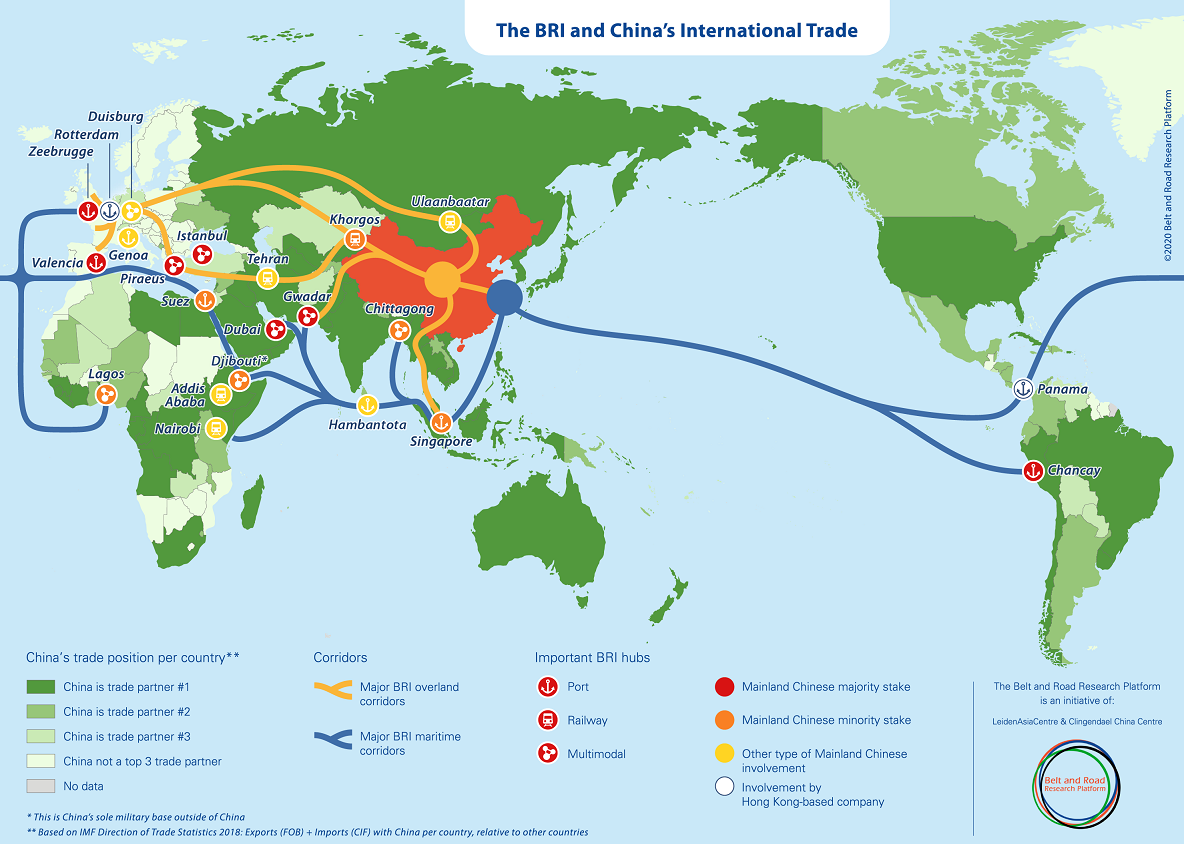
The Belt and Road Research Platform has developed a new map to display the Belt and Road Initiative in relation to China’s international trade. Although there are already plenty of maps which attempt to display the Belt and Road Initiative, we believe that there was a need for a novel approach: integrating the BRI into China’s international trade patterns.
https://www.clingendael.org/publication/new-map-belt-and-road-initiative
The Belt and Road Research Platform has developed a new map to display the Belt and Road Initiative in relation to China’s international trade. Although there are already plenty of maps which attempt to display the Belt and Road Initiative, we believe that there was a need for a novel approach: integrating the BRI into China’s international trade patterns.
Verra
https://verra.org/
Verra sets the world’s leading standards for climate action and sustainable development. ? We build standards for activities as diverse as reducing deforestation, to improving agricultural practices, to addressing plastic waste, and to achieving gender equality.
https://verra.org/
Verra sets the world’s leading standards for climate action and sustainable development. ? We build standards for activities as diverse as reducing deforestation, to improving agricultural practices, to addressing plastic waste, and to achieving gender equality.
Adam Tooze on Deglobalisation
On deglobalisation and polycrisis
"Imagine if China was attacking Apple’s manufacturing network, as the United States is attacking not just Huawei but the entire sector of high-tech microelectronics in China. And then imagine that Beijing blandly declared that this should not be taken as an attack on America’s economic development in general; just on the bits that matter for strategic purposes. Imagine how Washington and the American political system would react."
On deglobalisation and polycrisis
"Imagine if China was attacking Apple’s manufacturing network, as the United States is attacking not just Huawei but the entire sector of high-tech microelectronics in China. And then imagine that Beijing blandly declared that this should not be taken as an attack on America’s economic development in general; just on the bits that matter for strategic purposes. Imagine how Washington and the American political system would react."
Forty percent of all shipping cargo consists of fossil fuels
https://qz.com/2113243/forty-percent-of-all-shipping-cargo-consists-of-fossil-fuels
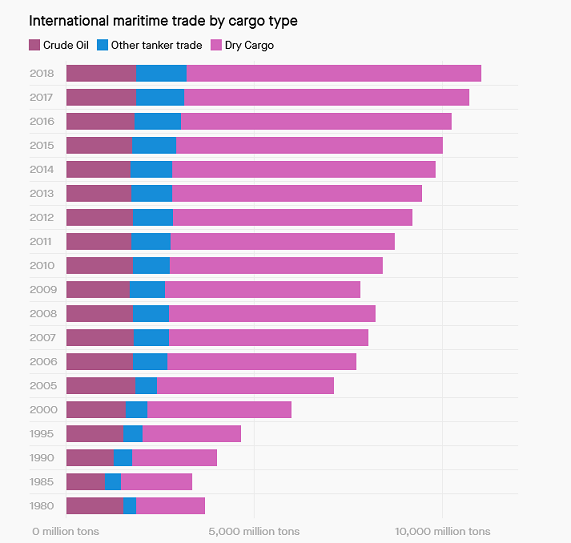
Cargo ships schlep thousands of millions of tons of cargo around the world every year, belching out 3% of the world’s greenhouse gas emissions as they traverse the seas. But the real damage is done by the contents of their holds. By weight, 40% of maritime trade consists either of fossil fuels on their way to be burned or of chemicals derived directly from fossil fuels.
https://qz.com/2113243/forty-percent-of-all-shipping-cargo-consists-of-fossil-fuels
Cargo ships schlep thousands of millions of tons of cargo around the world every year, belching out 3% of the world’s greenhouse gas emissions as they traverse the seas. But the real damage is done by the contents of their holds. By weight, 40% of maritime trade consists either of fossil fuels on their way to be burned or of chemicals derived directly from fossil fuels.
Fish4Ever Traceability
https://fish4ever.co.uk/

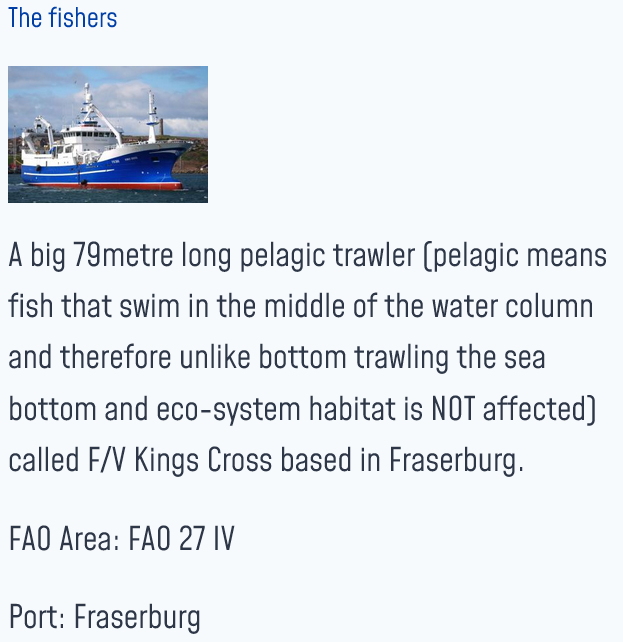
In the local eco-shop I bought a tin of mackerel from Fish4Ever for no other reason than that it promised traceability of the fish back to the boat that caught it. I had not heard of this company/advocacy group before but from this somewhat older interview I learned that they are also campaigning for MSC to be more strict on some aspects of fisheries. Earlier I looked at the same functionality offered by John West.


The code takes me to this page which contains not just a deep level of factual information on this fishery (species, catching method, catching area) but also a detailed statement on why they sell this particular mackerel even while it lost its MSC certification, this again branching out in the wider implications of climate change and conflicts in governance in relation to conversation areas.
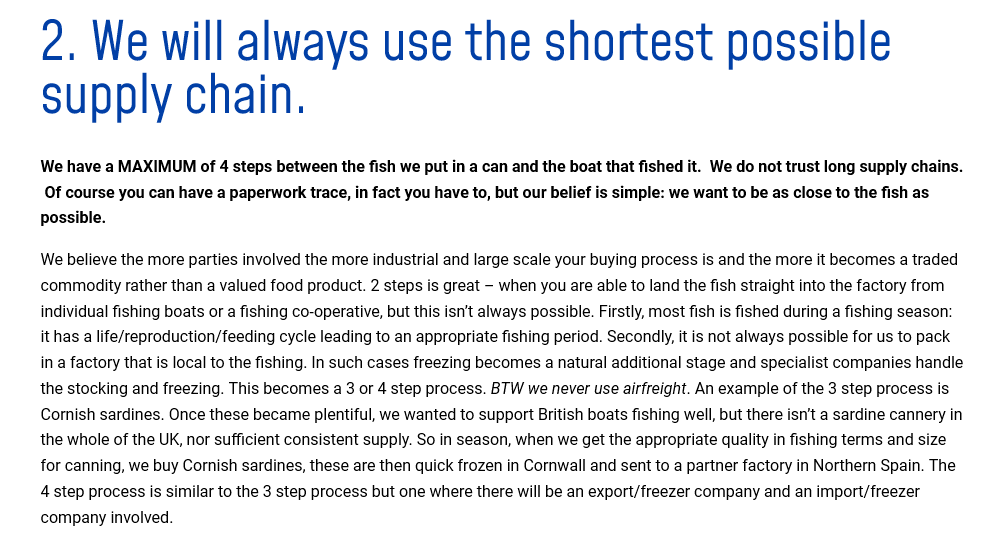
This is a really good source of information on a product level, especially when you compare it with John West. It you are going to be annoying I would say that traceability is not just about showing the physical source but the entire chain: who processed and canned, storage points, age of the product. It’s not easy, but if we are looking for the avant-garde of traceability that is what we look for. Fish4Ever does has an informative page on their Quality Charter. Point 2 “We will always use the shortest possible supply chain” is relevant here, but again: show it! But I am not complaining this is a really nice traceability service that can serve as an example to many others. What I also like about it is that the traceability is so central to their value proposition. Really Cool.
https://fish4ever.co.uk/
In the local eco-shop I bought a tin of mackerel from Fish4Ever for no other reason than that it promised traceability of the fish back to the boat that caught it. I had not heard of this company/advocacy group before but from this somewhat older interview I learned that they are also campaigning for MSC to be more strict on some aspects of fisheries. Earlier I looked at the same functionality offered by John West.
The code takes me to this page which contains not just a deep level of factual information on this fishery (species, catching method, catching area) but also a detailed statement on why they sell this particular mackerel even while it lost its MSC certification, this again branching out in the wider implications of climate change and conflicts in governance in relation to conversation areas.
This is a really good source of information on a product level, especially when you compare it with John West. It you are going to be annoying I would say that traceability is not just about showing the physical source but the entire chain: who processed and canned, storage points, age of the product. It’s not easy, but if we are looking for the avant-garde of traceability that is what we look for. Fish4Ever does has an informative page on their Quality Charter. Point 2 “We will always use the shortest possible supply chain” is relevant here, but again: show it! But I am not complaining this is a really nice traceability service that can serve as an example to many others. What I also like about it is that the traceability is so central to their value proposition. Really Cool.
Article; How We Broke the Supply Chain
https://prospect.org/economy/how-we-broke-the-supply-chain-intro/
Almost none of these stories will explain how these shortages and price hikes were also brought to life through bad public policy coupled with decades of corporate greed. We spent a half-century allowing business executives and financiers to take control of our supply chains, enabled by leaders in both parties. They all hailed the transformation, cheering the advances of globalization, the efficient network that would free us from want. Motivated by greed and dismissive of the public interest, they didn’t mention that their invention was supremely ill-equipped to handle inevitable supply bottlenecks. And the pandemic exposed this hidden risk, like a domino bringing down a system primed to topple.
https://prospect.org/economy/how-we-broke-the-supply-chain-intro/
Almost none of these stories will explain how these shortages and price hikes were also brought to life through bad public policy coupled with decades of corporate greed. We spent a half-century allowing business executives and financiers to take control of our supply chains, enabled by leaders in both parties. They all hailed the transformation, cheering the advances of globalization, the efficient network that would free us from want. Motivated by greed and dismissive of the public interest, they didn’t mention that their invention was supremely ill-equipped to handle inevitable supply bottlenecks. And the pandemic exposed this hidden risk, like a domino bringing down a system primed to topple.
Personal Website; Francisco Blaha
http://www.franciscoblaha.info
Blaha is an independent fishieries adviser with great knowledge (and opinions) on the many aspects of industry oversight and regulation
http://www.franciscoblaha.info
Blaha is an independent fishieries adviser with great knowledge (and opinions) on the many aspects of industry oversight and regulation
Stappenplan Internationaal Maatschappelijk Verantwoord Ondernemen (IMVO)
https://ondernemersplein.kvk.nl/internationaal-mvo/
Doet u internationaal zaken? Dan verwacht de overheid dat u internationaal maatschappelijk verantwoord onderneemt (IMVO). Soms moet u hier ook verslag over doen bij de overheid. In 2023 worden Europese wetten verwacht die MVO minder vrijblijvend maken. Begin daarom nu al met de eerste stappen voor IMVO.
https://ondernemersplein.kvk.nl/internationaal-mvo/
Doet u internationaal zaken? Dan verwacht de overheid dat u internationaal maatschappelijk verantwoord onderneemt (IMVO). Soms moet u hier ook verslag over doen bij de overheid. In 2023 worden Europese wetten verwacht die MVO minder vrijblijvend maken. Begin daarom nu al met de eerste stappen voor IMVO.
Checklist in de keten
https://www.mvorisicochecker.nl/
Gebruik deze interactieve checklist om je invloed in je toeleveringsketen te vergroten. Leer gerichter actie te ondernemen om de MVO-prestaties van je leveranciers te beïnvloeden.
https://www.mvorisicochecker.nl/
Gebruik deze interactieve checklist om je invloed in je toeleveringsketen te vergroten. Leer gerichter actie te ondernemen om de MVO-prestaties van je leveranciers te beïnvloeden.
Boskalis dreigt met vertrek uit Nederland
https://nos.nl/artikel/2458887-boskalis-dreigt-met-vertrek-uit-nederland-nieuwe-wet-maakt-ondernemen-onzeker
Het gaat om de wet Internationaal Maatschappelijk Verantwoord Ondernemen. Die loopt vooruit op Europese wetgeving waarin aan bedrijven over verantwoord ondernemen verplichtingen worden opgelegd. Berdowski maakt zich met name zorgen over een mogelijke zorgplicht. Bedrijven moeten voorkomen dat hun activiteiten negatieve gevolgen hebben voor zaken als mensenrechten, arbeidsrechten of het milieu. Een rechter zou dat kunnen toetsen.
https://nos.nl/artikel/2458887-boskalis-dreigt-met-vertrek-uit-nederland-nieuwe-wet-maakt-ondernemen-onzeker
Het gaat om de wet Internationaal Maatschappelijk Verantwoord Ondernemen. Die loopt vooruit op Europese wetgeving waarin aan bedrijven over verantwoord ondernemen verplichtingen worden opgelegd. Berdowski maakt zich met name zorgen over een mogelijke zorgplicht. Bedrijven moeten voorkomen dat hun activiteiten negatieve gevolgen hebben voor zaken als mensenrechten, arbeidsrechten of het milieu. Een rechter zou dat kunnen toetsen.
Open database on global coal and metal mine production
https://zenodo.org/record/7328050#.Y7_kExWZND8
This data set covers global extraction of coal and metal ores on an individual mine level. It covers 1171 individual mines in 80 different countries, reporting mine-level production for 80 different materials in the period 2000-2021. Furthermore, also data on mining coordinates, ownership, mineral reserves, mining waste, transportation of mining products,as well as mineral processing capacities (smelters and mineral refineries) and production is included. The data was gathered manually from more than 1900 openly available sources, such as annual or sustainability reports of mining companies. All datapoints are linked to their respective source documents. After manual screening and entry of the data, automatic cleaning, harmonization and data checking was conducted. Geoinformation was obtained either from coordinates available in company reports, or by retrieving the coordinates via Google Maps API and subsequent manual checking. For mines where no coordinates could be found, other geospatial attributes such as province, region, district or municipality were recorded, and linked to the GADM data set, available at www.gadm.org.
https://zenodo.org/record/7328050#.Y7_kExWZND8
This data set covers global extraction of coal and metal ores on an individual mine level. It covers 1171 individual mines in 80 different countries, reporting mine-level production for 80 different materials in the period 2000-2021. Furthermore, also data on mining coordinates, ownership, mineral reserves, mining waste, transportation of mining products,as well as mineral processing capacities (smelters and mineral refineries) and production is included. The data was gathered manually from more than 1900 openly available sources, such as annual or sustainability reports of mining companies. All datapoints are linked to their respective source documents. After manual screening and entry of the data, automatic cleaning, harmonization and data checking was conducted. Geoinformation was obtained either from coordinates available in company reports, or by retrieving the coordinates via Google Maps API and subsequent manual checking. For mines where no coordinates could be found, other geospatial attributes such as province, region, district or municipality were recorded, and linked to the GADM data set, available at www.gadm.org.
Map of Lithium Reserves
https://www2.bgs.ac.uk/mineralsuk/download/global_critical_metal_deposit_maps/G2122_052_V4CMYK.pdf
https://www2.bgs.ac.uk/mineralsuk/download/global_critical_metal_deposit_maps/G2122_052_V4CMYK.pdf
Article, Ghost Ships
https://logicmag.io/pivot/ghost-ships/
Squinting against the sun, I tried to imagine the ships another way: as numbers on a screen, cells in a spreadsheet, dots on a grid. I’d been reading about the information transfer that accompanies the movement of these vessels, and I knew that the scale of this data is nearly as impressive as the ships’ sheer size. Ships like those docked at Long Beach are vital links in the global supply chain, but they’re also floating “data terminals,” as the global maritime industry consultancy Lloyd’s Register put it in 2015. Increasingly, these vessels receive and transmit an enormous amount of information: about their position, of course, but also about weather, traffic, temperature, maintenance, staffing, ocean conditions, and much more. The streams of information are so complex that they threaten to exceed humans’ ability to interpret them. That’s partly why many newer vessels—“smart ships,” in industry parlance—use complex algorithms (some of them devised by Google and Microsoft) to chart their courses. Within the next decade, carriers hope to launch fleets of automated or remote-controlled vessels—“ghost ships,” as they’re sometimes called.
https://logicmag.io/pivot/ghost-ships/
Squinting against the sun, I tried to imagine the ships another way: as numbers on a screen, cells in a spreadsheet, dots on a grid. I’d been reading about the information transfer that accompanies the movement of these vessels, and I knew that the scale of this data is nearly as impressive as the ships’ sheer size. Ships like those docked at Long Beach are vital links in the global supply chain, but they’re also floating “data terminals,” as the global maritime industry consultancy Lloyd’s Register put it in 2015. Increasingly, these vessels receive and transmit an enormous amount of information: about their position, of course, but also about weather, traffic, temperature, maintenance, staffing, ocean conditions, and much more. The streams of information are so complex that they threaten to exceed humans’ ability to interpret them. That’s partly why many newer vessels—“smart ships,” in industry parlance—use complex algorithms (some of them devised by Google and Microsoft) to chart their courses. Within the next decade, carriers hope to launch fleets of automated or remote-controlled vessels—“ghost ships,” as they’re sometimes called.
Article, AIS spoofing
https://www.gpsworld.com/spoofing-in-the-black-sea-what-really-happened/
We’ve heard a lot in the news recently about GPS spoofing, mostly centred on the story of ship spoofing in the Black Sea. Between June 22-24, a number of ships in the Black Sea reported anomalies with their GPS-derived position, and found themselves apparently located at an airport. What happened is open to educated conjecture. In this column, I’ll briefly cover the history of spoofing, its basic techniques, some spoofing tests that we conducted, and then return to the infamous Black Sea incident.
https://www.gpsworld.com/spoofing-in-the-black-sea-what-really-happened/
We’ve heard a lot in the news recently about GPS spoofing, mostly centred on the story of ship spoofing in the Black Sea. Between June 22-24, a number of ships in the Black Sea reported anomalies with their GPS-derived position, and found themselves apparently located at an airport. What happened is open to educated conjecture. In this column, I’ll briefly cover the history of spoofing, its basic techniques, some spoofing tests that we conducted, and then return to the infamous Black Sea incident.
Von der Leyen Tweet

Mine-to-manufacturer traceability of a conflict mineral
https://www.hyperledger.org/learn/publications/tantalum-case-study
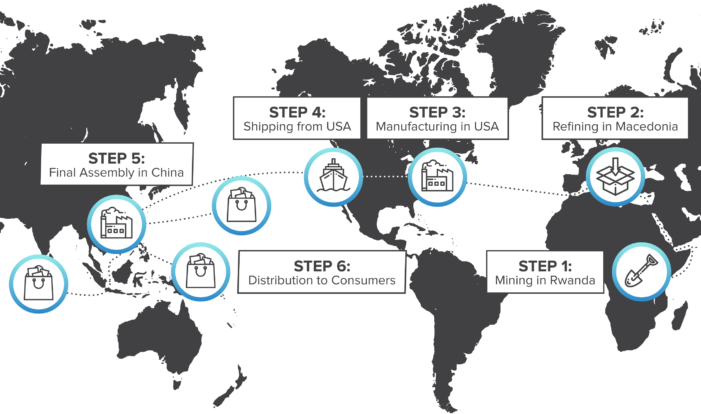
UK-based Circulor created a system that ensures tantalum is mined, transported, and processed under approved conditions with an unbroken chain of custody. Powered by a permissioned blockchain built on Hyperledger Fabric, the system uses facial recognition and QR codes to deliver a world first: mine-to-manufacturer traceability of this vital resource.
https://www.hyperledger.org/learn/publications/tantalum-case-study
UK-based Circulor created a system that ensures tantalum is mined, transported, and processed under approved conditions with an unbroken chain of custody. Powered by a permissioned blockchain built on Hyperledger Fabric, the system uses facial recognition and QR codes to deliver a world first: mine-to-manufacturer traceability of this vital resource.
Mine Tracker
https://trace-and-traceability.org/MineTracker.php
The Mine Tracker dataset is a continuously updated open source database of active metal mines across the globe. Starting in January 2023 with 178 copper mines Mine Trackers will soon also include other metals such as lithium, tin, tungsten, tantalum and cobalt mines.
All entries are all manually checked and sourced from public records to include per mine its name, its location (longitude, latitude, address, country), ownership, metals mined and a URL and description (optional). Availability of information is not evenly spread, Wikipedia quality is uneven, language barriers are real. It is not perfect but we do are best.
Mining is not an environmentally neutral activity and the tool allows you to navigate to gigantic open pit mines scarring remote landscapes. It has its beauty but only from the safe distance of a satellite image. The ability to trace raw materials and products through a supply chain starts with mapping out the production areas and this is the core aim of the Mine Tracker database.
Revisions, remarks? Contact me via
jane {.} austen {at} trace-and-traceability {.} org
https://mastodon.online/@traceability
https://trace-and-traceability.org/MineTracker.php
The Mine Tracker dataset is a continuously updated open source database of active metal mines across the globe. Starting in January 2023 with 178 copper mines Mine Trackers will soon also include other metals such as lithium, tin, tungsten, tantalum and cobalt mines.
All entries are all manually checked and sourced from public records to include per mine its name, its location (longitude, latitude, address, country), ownership, metals mined and a URL and description (optional). Availability of information is not evenly spread, Wikipedia quality is uneven, language barriers are real. It is not perfect but we do are best.
Mining is not an environmentally neutral activity and the tool allows you to navigate to gigantic open pit mines scarring remote landscapes. It has its beauty but only from the safe distance of a satellite image. The ability to trace raw materials and products through a supply chain starts with mapping out the production areas and this is the core aim of the Mine Tracker database.
Revisions, remarks? Contact me via
jane {.} austen {at} trace-and-traceability {.} org
https://mastodon.online/@traceability
Book; The Supply Chain Revolution
https://www.goodreads.com/book/show/35386752-the-supply-chain-revolution

This is one of those airport bestsellers you know will be bad but read anyway just to reaffirm your bias. Most of this deals not so much with supply chains, has nothing revolutionary to tell and most of all is so narrowly focused on profit that any business would be bankrupted be following it. The real revolutions in supply chain management are all focused on digitization, provenance, quality and sustainability. None of these are mentioned.
https://www.goodreads.com/book/show/35386752-the-supply-chain-revolution
This is one of those airport bestsellers you know will be bad but read anyway just to reaffirm your bias. Most of this deals not so much with supply chains, has nothing revolutionary to tell and most of all is so narrowly focused on profit that any business would be bankrupted be following it. The real revolutions in supply chain management are all focused on digitization, provenance, quality and sustainability. None of these are mentioned.
Article, How a Cocaine-Smuggling Cartel Infiltrated the World’s Biggest Shipping Company
https://archive.vn/8rRn2
As MSC grew into a dominant force in global trade, it also became a prime drug-trafficking conduit for Balkan gangs.
https://archive.vn/8rRn2
As MSC grew into a dominant force in global trade, it also became a prime drug-trafficking conduit for Balkan gangs.
Arctic Infrastructure Inventory
https://arcticinfrastructure.wilsoncenter.org/
he Arctic Infrastructure Inventory (AII) tracks infrastructure projects in the Arctic. With nearly 8,000 projects listed, and thousands more that will be added as it grows, AII aims to be a tool and resource for all stakeholders in Arctic infrastructure—including policymakers, industry, researchers, community leaders, and more.
https://arcticinfrastructure.wilsoncenter.org/
he Arctic Infrastructure Inventory (AII) tracks infrastructure projects in the Arctic. With nearly 8,000 projects listed, and thousands more that will be added as it grows, AII aims to be a tool and resource for all stakeholders in Arctic infrastructure—including policymakers, industry, researchers, community leaders, and more.
Article, Droughts and Dams
https://www.phenomenalworld.org/analysis/droughts-and-dams/
Most of Zambia’s grid electricity is generated by hydropower. Over the past decade, recurring droughts—in 2015, 2016, 2019, and now again in 2022—have exposed deep vulnerabilities in the system. These droughts have unleashed unprecedented power outages, with low reservoir levels constraining hydroelectricity generation capacity.
https://www.phenomenalworld.org/analysis/droughts-and-dams/
Most of Zambia’s grid electricity is generated by hydropower. Over the past decade, recurring droughts—in 2015, 2016, 2019, and now again in 2022—have exposed deep vulnerabilities in the system. These droughts have unleashed unprecedented power outages, with low reservoir levels constraining hydroelectricity generation capacity.
Article, A global-scale data set of mining areas
https://www.nature.com/articles/s41597-020-00624-w

The area used for mineral extraction is a key indicator for understanding and mitigating the environmental impacts caused by the extractive sector. To date, worldwide data products on mineral extraction do not report the area used by mining activities. In this paper, we contribute to filling this gap by presenting a new data set of mining extents derived by visual interpretation of satellite images. We delineated mining areas within a 10?km buffer from the approximate geographical coordinates of more than six thousand active mining sites across the globe. The result is a global-scale data set consisting of 21,060 polygons that add up to 57,277?km2. The polygons cover all mining above-ground features that could be identified from the satellite images, including open cuts, tailings dams, waste rock dumps, water ponds, and processing infrastructure.
https://www.nature.com/articles/s41597-020-00624-w
The area used for mineral extraction is a key indicator for understanding and mitigating the environmental impacts caused by the extractive sector. To date, worldwide data products on mineral extraction do not report the area used by mining activities. In this paper, we contribute to filling this gap by presenting a new data set of mining extents derived by visual interpretation of satellite images. We delineated mining areas within a 10?km buffer from the approximate geographical coordinates of more than six thousand active mining sites across the globe. The result is a global-scale data set consisting of 21,060 polygons that add up to 57,277?km2. The polygons cover all mining above-ground features that could be identified from the satellite images, including open cuts, tailings dams, waste rock dumps, water ponds, and processing infrastructure.
National Resource Governance Institute
https://www.resourcegovernance.org
NRGI’s aim is that countries rich in oil, gas and minerals achieve sustainable, inclusive development, and that people receive lasting benefits from the extractive sector and experience reduced harms.
https://www.resourcegovernance.org
NRGI’s aim is that countries rich in oil, gas and minerals achieve sustainable, inclusive development, and that people receive lasting benefits from the extractive sector and experience reduced harms.
Austalian Mines Dataset
https://catalogue.data.wa.gov.au/dataset/operating-mines/resource/f5453f34-2f4d-40b8-8b66-365b39351eec?inner_span=True
MINEDEX provides a coordinated, project-based enquiry system for textual information on mine, deposits, prospects, etc., and related infrastructure. The Operating Mine Map custom data extract is a regularly-updated point representation of the State's mines that have a Status of either operating or under development that appear on an annually produced map. The mines are automatically selected by Status and updated regularly.
https://catalogue.data.wa.gov.au/dataset/operating-mines/resource/f5453f34-2f4d-40b8-8b66-365b39351eec?inner_span=True
MINEDEX provides a coordinated, project-based enquiry system for textual information on mine, deposits, prospects, etc., and related infrastructure. The Operating Mine Map custom data extract is a regularly-updated point representation of the State's mines that have a Status of either operating or under development that appear on an annually produced map. The mines are automatically selected by Status and updated regularly.
Article, Big Brands and the wild west of supply chains
https://www.theguardian.com/world/2022/dec/19/how-big-brands-like-tesco-are-drawn-to-wild-west-of-global-supply-chain
Hundreds of factories surround the border city of Mae Sot in the far west of Thailand. It is so close to Myanmar that at times the bombs of the civil war can be heard from its centre. Almost all the garment factories here rely on the flow of cheap Burmese labour fleeing war and economic hardship. Their hard work, willingness to accept pay well below the Thai minimum wage and a lack of legal rights make them an attractive prospect for factories trying to cut costs. And the sale price of what they produce on these tiny wages attracts big brands.
https://www.theguardian.com/world/2022/dec/19/how-big-brands-like-tesco-are-drawn-to-wild-west-of-global-supply-chain
Hundreds of factories surround the border city of Mae Sot in the far west of Thailand. It is so close to Myanmar that at times the bombs of the civil war can be heard from its centre. Almost all the garment factories here rely on the flow of cheap Burmese labour fleeing war and economic hardship. Their hard work, willingness to accept pay well below the Thai minimum wage and a lack of legal rights make them an attractive prospect for factories trying to cut costs. And the sale price of what they produce on these tiny wages attracts big brands.
What is a Heat Number?
https://en.wikipedia.org/wiki/Heat_number
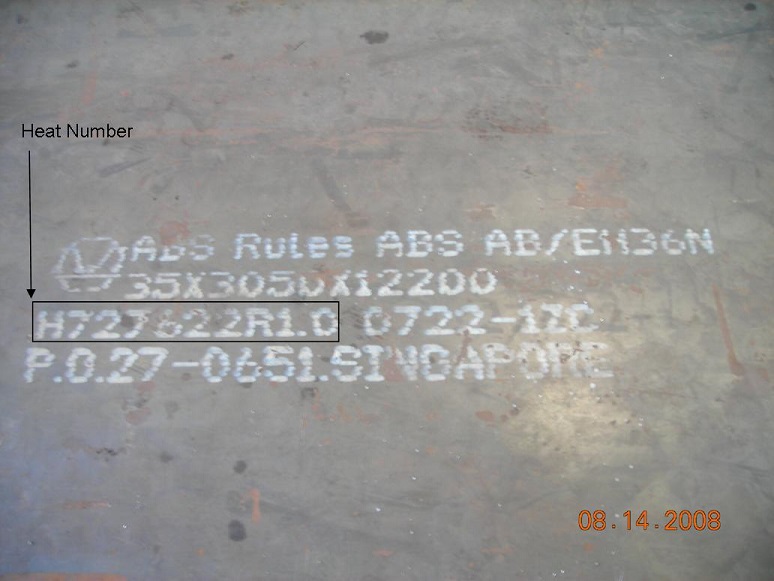
A heat number is an identification coupon number that is stamped on a material plate after it is removed from the ladle and rolled at a steel mill. Industry quality standards require materials to be tested at the manufacturer and the results of these tests be submitted through a report, also called a mill sheet, mill certificate or mill test certificate (MTC). The only way to trace a steel plate back to its mill sheet is the heat number. A heat number is similar to a lot number, which is used to identify production runs of any other product for quality control purposes.
https://en.wikipedia.org/wiki/Heat_number
A heat number is an identification coupon number that is stamped on a material plate after it is removed from the ladle and rolled at a steel mill. Industry quality standards require materials to be tested at the manufacturer and the results of these tests be submitted through a report, also called a mill sheet, mill certificate or mill test certificate (MTC). The only way to trace a steel plate back to its mill sheet is the heat number. A heat number is similar to a lot number, which is used to identify production runs of any other product for quality control purposes.
Material Traceability
https://www.xometry.com/resources/shop-tips/understanding-material-traceability/
https://www.xometry.com/resources/shop-tips/understanding-material-traceability/
What is Material Traceability?
At its simplest, material traceability is the process of ensuring that the materials that make up all the parts on a finished product have records spanning back to their production. This is often achieved with a paper trail. Material traceability must not be confused with product traceability which allows more granular tracking of the product and can include details such as when it was manufactured, who manufactured it, and which machines were used.
The process of making a product materially traceable starts with the procurement of the required materials. These materials should be delivered with a batch certificate, material certificate, or mill test report (MTR). Despite the different names, these documents refer to essentially the same thing.
In the case of metals, the material certificate allows for the tracking of the material all the way to the specific ladle of molten metal used. The number used to identify a specific batch or “heat” of molten metal is called the heat number. In addition to this, the material certificate will indicate the date the material was cast, the elemental makeup, results of mechanical tests, and the standards with which it complies, amongst other details. Most materials that have verified mechanical properties will have a material certificate and associated heat number. In the case of plastics, the term, “batch certificate,” is often used instead.
A material certificate is important as it proves that the material meets its standardized properties. After all, engineers select the specific grade of stock based on its mechanical properties and need confirmation that the batch they receive is up to spec. The material certificate exists as proof that the material has been manufactured according to the relevant standards. It therefore must be linked to the material via a permanent label on the material itself. This can come in the form of hard-punching, tags, indelible paint, or (in the case of plastic) stickers.
Zergatran, Company Website
https://www.zergratran.com/

Zergratran is an innovative and sustainable high-capacity transportation company that is building the world’s first tunnel to expedite shipping goods between the North Atlantic and the North Pacific. In doing so it will offer faster, smarter, safer and cheaper solutions to existing alternatives.
https://www.zergratran.com/
Zergratran is an innovative and sustainable high-capacity transportation company that is building the world’s first tunnel to expedite shipping goods between the North Atlantic and the North Pacific. In doing so it will offer faster, smarter, safer and cheaper solutions to existing alternatives.
We assume the temporal is permanent
https://en.wikipedia.org/wiki/The_Economic_Consequences_of_the_Peace
https://en.wikipedia.org/wiki/The_Economic_Consequences_of_the_Peace
The power to become habituated to his surroundings is a marked characteristic of mankind. Very few of us realize with conviction the intensely unusual, unstable, complicated, unreliable, temporary nature of the economic organization by which Western Europe has lived for the last half century. We assume some of the most peculiar and temporary of our late advantages as natural, permanent, and to be depended on, and we lay our plans accordingly. On this sandy and false foundation we scheme for social improvement and dress our political platforms, pursue our animosities and particular ambitions, and feel ourselves with enough margin in hand to foster, not assuage, civil conflict in the European family.This is how Maynard Keynes' The Economic Consequences of Peace (1919) starts. After more than a 100 years this seems a good place to start in our own analysis of our current complacency about the inevitablity, reliability and security of global supply chains that structure our trade, economic, political and social environment today.
Dell Theory of Conflict Prevention
https://en.wikipedia.org/wiki/The_World_Is_Flat
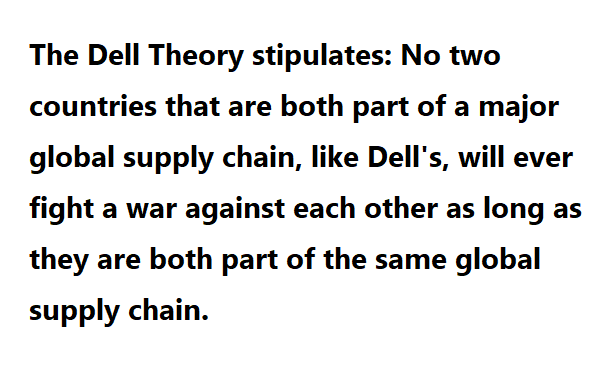
A divine peace of wisdom from Thomas Friedman's The Word is Flat (2005). The Argument predates the first word war.
https://en.wikipedia.org/wiki/The_World_Is_Flat
A divine peace of wisdom from Thomas Friedman's The Word is Flat (2005). The Argument predates the first word war.
Paper, Transforming Intel’s Supply Chain with Real-Time Analytics 2017
https://www.intel.com/content/dam/www/public/us/en/documents/white-papers/transforming-supply-chain-with-real-time-analytics-whitepaper.pdf

The platform will deliver the following capabilities:
- Simplified supply chain and data pipelines
- Self-service analysis, which enables planners to make faster and better decisions
- Improved data quality by eliminating the reconciliation of data across systems
- Real-time analytics that identify, diagnose, and respond to issues
We plan to continue to add more advanced predictive analytics to enhance our “sense-and-respond” supply chain.
https://www.intel.com/content/dam/www/public/us/en/documents/white-papers/transforming-supply-chain-with-real-time-analytics-whitepaper.pdf
The platform will deliver the following capabilities:
- Simplified supply chain and data pipelines
- Self-service analysis, which enables planners to make faster and better decisions
- Improved data quality by eliminating the reconciliation of data across systems
- Real-time analytics that identify, diagnose, and respond to issues
We plan to continue to add more advanced predictive analytics to enhance our “sense-and-respond” supply chain.
Maritrace, Company Website
https://www.ww3.maritrace.com/
We process trillions of maritime data points to measure how vessels and cargos move around the world. From assessing risk to understanding supply and demand.
https://www.ww3.maritrace.com/
We process trillions of maritime data points to measure how vessels and cargos move around the world. From assessing risk to understanding supply and demand.
Submarine Cable Map 2022
https://submarine-cable-map-2022.telegeography.com/
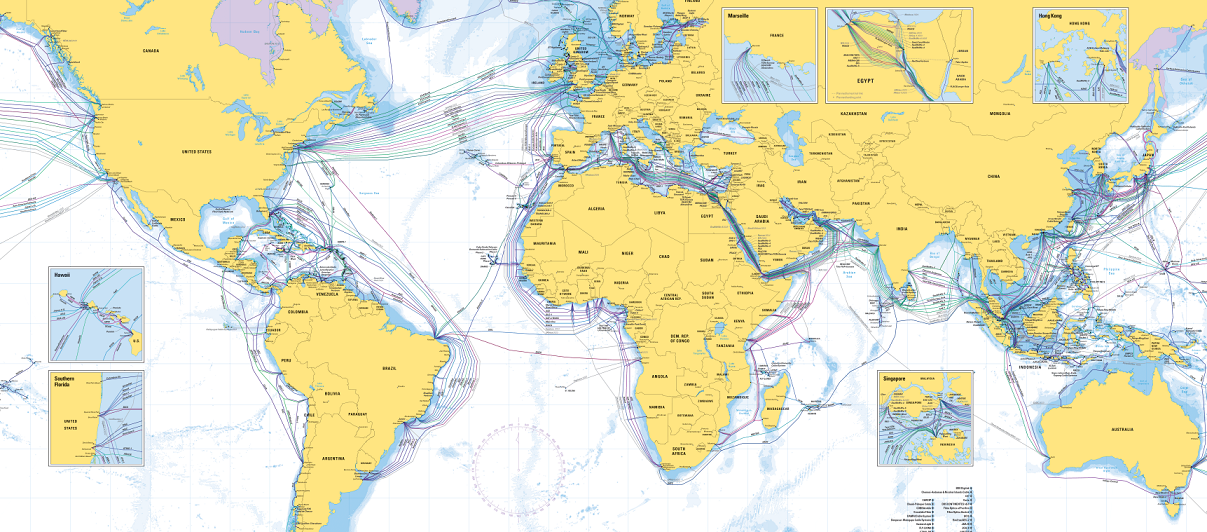
This new edition depicts 486 cable systems and 1,306 landings that are currently active or under construction.
https://submarine-cable-map-2022.telegeography.com/
This new edition depicts 486 cable systems and 1,306 landings that are currently active or under construction.
Oil Tanker Dark Fleets
https://lloydslist.maritimeintelligence.informa.com/LL1142833/Dark-fleet-danger-as-accident-prone-elderly-tankers-anchor-off-Malaysia
A TOTAL of 43 large tankers with an average age of 20 years, all engaged in deceptive practices linked with shipping sanctioned crude, were at anchor off the eastern coast of Malaysia in the past week, amplifying marine casualty risks near one of the world’s crucial oil trade arteries. There have been two casualties in the past six weeks off Singapore, involving elderly tankers that have been at anchor in the area and identified as shipping US-sanctioned Iranian and Venezuelan oil trades. The 43 anchoring tankers are part of a seaborne logistics base for Iranian, Venezuelan and now Russia crude, and form a well-established network that has evolved over the past three years to evade sanctions.
https://lloydslist.maritimeintelligence.informa.com/LL1142833/Dark-fleet-danger-as-accident-prone-elderly-tankers-anchor-off-Malaysia
A TOTAL of 43 large tankers with an average age of 20 years, all engaged in deceptive practices linked with shipping sanctioned crude, were at anchor off the eastern coast of Malaysia in the past week, amplifying marine casualty risks near one of the world’s crucial oil trade arteries. There have been two casualties in the past six weeks off Singapore, involving elderly tankers that have been at anchor in the area and identified as shipping US-sanctioned Iranian and Venezuelan oil trades. The 43 anchoring tankers are part of a seaborne logistics base for Iranian, Venezuelan and now Russia crude, and form a well-established network that has evolved over the past three years to evade sanctions.
ABS Wavesight, Company Website
https://www.abswavesight.com/
Maritime SaaS for risk and fleet management
https://www.abswavesight.com/
Maritime SaaS for risk and fleet management
Report, DataPorts Solving End-to-End Value Chain Content Integration
https://www.theconsumergoodsforum.com/wp-content/uploads/members-content/E2E-dataports-solving-end-to-end-value-chain-content-integration.pdf

Today, when a retailer needs to assemble a complete view of informa- tion about a product for an online product catalogue, that retailer will typically go to multiple web-based sources, search for information, transform the information obtained into a format fit for purpose, and assemble the information elements for publication to the catalogue.
Today that content integration process is difficult. It is difficult because the steps of the process and the technology required for search and retrieval of information vary sufficiently from source to source, and even from item to item such that it is difficult to fully automate. The content integration problem blocks operational efficiency, in- troduces product information errors, and slows down the speed to market - resulting in increased costs and lost sales.
One of the approaches traditionally proposed for solving this con- tent integration problem is “data federation”. Data federation works by standardising on a common federated data model and map- ping all data sources to that standardised model. Content might be mapped either real-time in response to requests, or it might be stored using the common data model in an intermediate data store ready for consumption.
The challenge though is that agreeing on a standard model is difficult and despite big efforts and successes in standardisation across the value chain there always seem to be exceptions and in most cases there remains data which does not fit the model. We’ve been asked to find a more general way to share information such that partners can c
https://www.theconsumergoodsforum.com/wp-content/uploads/members-content/E2E-dataports-solving-end-to-end-value-chain-content-integration.pdf
Today, when a retailer needs to assemble a complete view of informa- tion about a product for an online product catalogue, that retailer will typically go to multiple web-based sources, search for information, transform the information obtained into a format fit for purpose, and assemble the information elements for publication to the catalogue.
Today that content integration process is difficult. It is difficult because the steps of the process and the technology required for search and retrieval of information vary sufficiently from source to source, and even from item to item such that it is difficult to fully automate. The content integration problem blocks operational efficiency, in- troduces product information errors, and slows down the speed to market - resulting in increased costs and lost sales.
One of the approaches traditionally proposed for solving this con- tent integration problem is “data federation”. Data federation works by standardising on a common federated data model and map- ping all data sources to that standardised model. Content might be mapped either real-time in response to requests, or it might be stored using the common data model in an intermediate data store ready for consumption.
The challenge though is that agreeing on a standard model is difficult and despite big efforts and successes in standardisation across the value chain there always seem to be exceptions and in most cases there remains data which does not fit the model. We’ve been asked to find a more general way to share information such that partners can c
Report, Data Ports in action
https://www.theconsumergoodsforum.com/wp-content/uploads/202004-CGF-E2E-DataPorts-in-Action-Paper.pdf
Managing and sharing product information across the entire value chain is still a fundamental challenge for the consumer goods and retail industry. The Board of The Consumer Good Fo- rum (CGF) acknowledges the need to move urgently and at scale beyond current industry and organisational paradigms to drive a step-change forward via the Product Data Coalition of Action. Most of the current initiatives have focused on managing and sharing product master data across the industry:
(1) verifying GTINs globally
(2) defining and maintaining a core set of product attributes and
(3) ensuring the best possible data quality via a consistent approach based on Data Quality Business Rules. In addition, there is a voluntary innovation track which has focused on new technologies to leapfrog data exchange (4) via DataPorts.
One of the key premises is that new technologies such as Arti- ficial Intelligence (AI) promise a future for data transformation, validation and exchange that is likely to be more responsive and accurate than current approaches. For that reason, we are currently exploring “DataPorts” as a new, easy and cost-efficient way to exchange data in a decentralised, federated manner across the whole value chain (including consumers), lever- aging technology innovations in cloud/APIs, AI and Machine Learning (ML). This new way of peer-to-peer data exchange allows for more automation and flexible dialogues between systems of trading partners.
https://www.theconsumergoodsforum.com/wp-content/uploads/202004-CGF-E2E-DataPorts-in-Action-Paper.pdf
Managing and sharing product information across the entire value chain is still a fundamental challenge for the consumer goods and retail industry. The Board of The Consumer Good Fo- rum (CGF) acknowledges the need to move urgently and at scale beyond current industry and organisational paradigms to drive a step-change forward via the Product Data Coalition of Action. Most of the current initiatives have focused on managing and sharing product master data across the industry:
(1) verifying GTINs globally
(2) defining and maintaining a core set of product attributes and
(3) ensuring the best possible data quality via a consistent approach based on Data Quality Business Rules. In addition, there is a voluntary innovation track which has focused on new technologies to leapfrog data exchange (4) via DataPorts.
One of the key premises is that new technologies such as Arti- ficial Intelligence (AI) promise a future for data transformation, validation and exchange that is likely to be more responsive and accurate than current approaches. For that reason, we are currently exploring “DataPorts” as a new, easy and cost-efficient way to exchange data in a decentralised, federated manner across the whole value chain (including consumers), lever- aging technology innovations in cloud/APIs, AI and Machine Learning (ML). This new way of peer-to-peer data exchange allows for more automation and flexible dialogues between systems of trading partners.
Data Ports
https://dataports-project.eu/

The main goal of the DataPorts project is to comprehensively address non-covered aspects of data platforms, with a specific application to transportation logistics in port environments in order to achieve cognitive PCS and improve data management between involved stakeholders.
DataPorts aims to design, develop, set-up and operate a data platform for the trusted, secure and reliable data sharing and trading among the actors operating in the diverse supply chains involved in the seaports, also enabling the connection with other stakeholders in the logistics supply chain. The adoption and use of this Data Platform by existing connected / digital ports will imply their transition to actual cognitive ports, taking real advantage of the huge amount of data produced by the stakeholders and opening the way to new capabilities:
- Real-time control of operations
- Streamlined decision making
- Accurate prediction of future events and situations
- Prescriptive analytics.
https://dataports-project.eu/
The main goal of the DataPorts project is to comprehensively address non-covered aspects of data platforms, with a specific application to transportation logistics in port environments in order to achieve cognitive PCS and improve data management between involved stakeholders.
DataPorts aims to design, develop, set-up and operate a data platform for the trusted, secure and reliable data sharing and trading among the actors operating in the diverse supply chains involved in the seaports, also enabling the connection with other stakeholders in the logistics supply chain. The adoption and use of this Data Platform by existing connected / digital ports will imply their transition to actual cognitive ports, taking real advantage of the huge amount of data produced by the stakeholders and opening the way to new capabilities:
- Real-time control of operations
- Streamlined decision making
- Accurate prediction of future events and situations
- Prescriptive analytics.
Advanced Semiconductor Supply Chain Dataset
https://eto.tech/dataset-docs/chipexplorer/
The Advanced Semiconductor Supply Chain Dataset includes manually compiled, high-level information about the tools, materials, processes, countries, and firms involved in the production of advanced logic chips. The current version of the dataset reflects how researchers understood this supply chain in early 2021. It uses a wide variety of sources, such as corporate websites and disclosures, specialized market research, and industry group publications.
https://eto.tech/dataset-docs/chipexplorer/
The Advanced Semiconductor Supply Chain Dataset includes manually compiled, high-level information about the tools, materials, processes, countries, and firms involved in the production of advanced logic chips. The current version of the dataset reflects how researchers understood this supply chain in early 2021. It uses a wide variety of sources, such as corporate websites and disclosures, specialized market research, and industry group publications.
The controversial way fashion brands gauge sustainability is being suspended
https://qz.com/2180322/the-controversial-higg-sustainability-index-is-being-suspended
The Higg Index, one of the fashion industry’s most well-known sustainability rating systems, came under sustained criticism this month. A New York Times article called out the index as too favorable to synthetic materials made from fossil fuels; the Intercept dug into the metric’s controversial ties to fast fashion; and the Norway Consumer Authority banned its use (link in Norwegian) in marketing to consumers.
https://qz.com/2180322/the-controversial-higg-sustainability-index-is-being-suspended
The Higg Index, one of the fashion industry’s most well-known sustainability rating systems, came under sustained criticism this month. A New York Times article called out the index as too favorable to synthetic materials made from fossil fuels; the Intercept dug into the metric’s controversial ties to fast fashion; and the Norway Consumer Authority banned its use (link in Norwegian) in marketing to consumers.